1. Introduction
On July 31, 2026, MiniMax (Xiyu Technology) officially unveiled its next-generation general-purpose multimodal generation model—MiniMax H3 (commonly referred to in the Chinese community as "Hailuo 3" or "Hailuo 3.0"). The announcement coincided with the opening day of the 2026 World Artificial Intelligence Conference (WAIC). MiniMax's choice of timing carries a clear statement: H3 is not merely an incremental update, but an effort to redefine the boundaries of AI video generation models.
Over the past two years, the AI video generation space has experienced explosive growth. Technology has evolved at a pace exceeding most expectations—moving from early academic prototypes capable of generating only a few seconds of blurry footage to commercial-grade short videos at 2K resolution with native stereo audio. However, a persistent problem has long plagued the industry: fragmentation across different modalities. Text-to-video (T2V), image-to-video (I2V), video editing, and audio generation are often handled by distinct models or pipelines. Users must constantly switch between multiple tools, suffering a loss of semantic information as assets move through the workflow. Ultimately, the quality of the final output depends heavily on a user's ability to "translate" their own creativity, rather than the model's ability to comprehend it.
H3’s core ambition is precisely to break down this fragmentation. It is not simply a text-to-video model, but a multimodal content creation engine that places text, images, video, and audio into a single unified context for comprehensive understanding, reference, editing, and regeneration [1]. You can simultaneously feed it a subject photo, a camera-movement video clip, a vocal audio track, and a text description, allowing it to grasp the relationships between all assets in one go—who the protagonist is, who provides the motion, who provides the voice, and where the visual style should head—before outputting a final video complete with sound.
This "omni-reference" capability remains rare among current commercial video models. Crucially, H3 also demonstrates aggressive pricing: 2K resolution generation costs only around ¥0.8 RMB per second, less than one-third of major competing products [1][8]. Combined with MiniMax's announcement that it will release open weights within days of launch, H3 has the potential to become the first flagship video generation model that is truly "high-quality, affordable, and self-hostable" [1].
Naturally, any new model release brings both excitement and caution. As of August 1, 2026, H3's full technical report has not yet been published; key parameters, training dataset sizes, loss functions, and other technical details remain undisclosed, and the open weights have yet to be delivered. While independent blind tests by Artificial Analysis rank H3 first in video editing tasks, these Elo scores reflect subjective user preference rather than absolute physical precision or frame-by-frame reconstruction fidelity [3].
This article offers a comprehensive, in-depth breakdown of MiniMax H3 across multiple dimensions, including technical architecture, core capabilities, competitive analysis, usage guides, pricing structure, open-source ecosystem, and current limitations or risks. Whether you are a content creator, a technical decision-maker, or an AI video researcher, you will find valuable insights here.
> Prefer learning by doing? Try MiniMax H3 (Hailuo 3) text-to-video and image-to-video with synced audio at minimaxh3.art—generate 2K-class short clips in the web studio.
2. Company Background
To appreciate the strategic significance of H3, it is helpful to look at its builder first.
MiniMax (Xiyu Technology) is one of China’s most representative foundational model companies. Headquartered in Shanghai, it was founded in 2021 by Yan Junjie, former Vice President of SenseTime. The company focuses on the research and development of large language models and multimodal generative models, backed by a star-studded lineup of investors including tech giants Alibaba and Tencent [4]. In January 2026, MiniMax completed its IPO in Hong Kong, raising approximately $619 million USD at a valuation of around $4 billion USD [4], becoming one of the most watched publicly listed AI companies in the region.
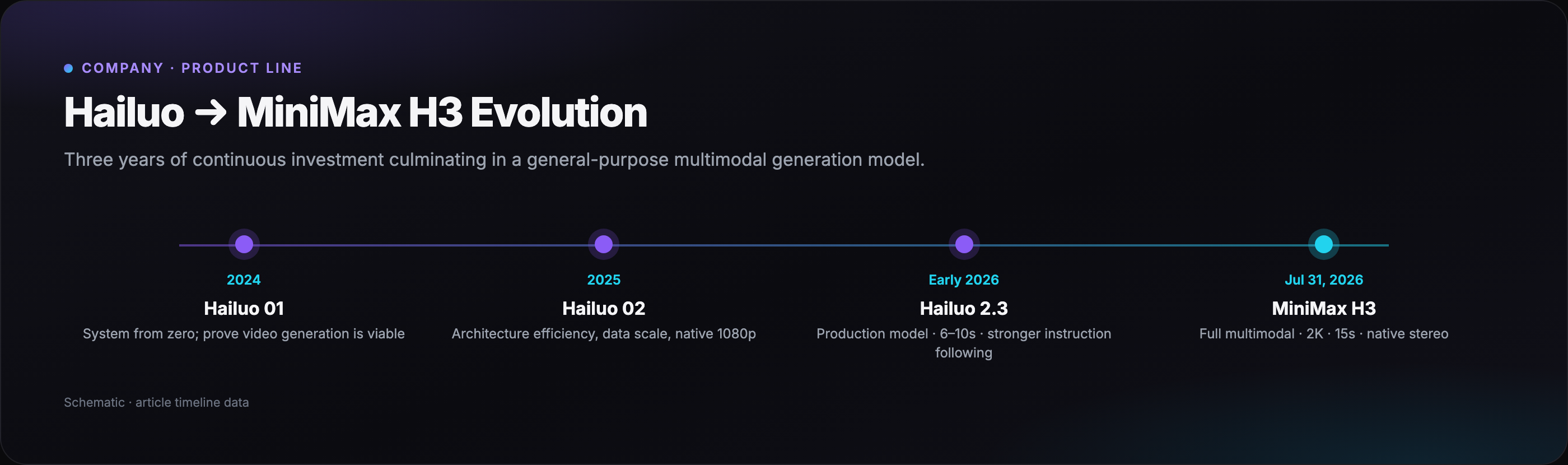
MiniMax’s consumer-facing video product brand is Hailuo, which built its reputation across creator communities through "accurate physics simulation, fast generation speed, and budget-friendly pricing." The iteration path of the Hailuo lineup is clear [4]:
| Version | Release Date | Key Positioning |
|---|---|---|
| Hailuo 01 | 2024 | Built systems from scratch, validating video generation feasibility |
| Hailuo 02 | 2025 | Focused on architectural efficiency, data quality, and scale; native 1080p |
| Hailuo 2.3 | Early 2026 | Mature production model; 1080p, 6–10 seconds, improved instruction following |
| MiniMax H3 | July 31, 2026 | General-purpose multimodal generation; 2K, 15 seconds, native stereo |
As this timeline illustrates, H3 is not an overnight release, but the culmination of three years of sustained investment by MiniMax in the video generation space.
Notably, H3 was not announced in isolation. At the same WAIC (World Artificial Intelligence Conference) 2026 event, MiniMax also launched the M3 large text model—a language model tailored for AI agent scenarios [4]. While H3 handles "seeing" and "hearing," M3 focuses on "thinking" and "reasoning." Together, they form MiniMax’s multimodal intelligence foundation. This dual layout of "visual generation + linguistic reasoning" highlights MiniMax's vision for future AI paradigms: truly valuable products will not focus on text or video alone, but will act as general-purpose agents that fluidly shift and collaborate across different modalities.
3. What is MiniMax H3
3.1 Official Definition
MiniMax H3 is officially defined as a general-purpose multimodal generation model. Every word in this definition is worth breaking down:
- General-purpose: Rather than a specialized model optimized for a single narrow task, it uses a unified architecture capable of handling text-to-video (T2V), image-to-video (I2V), video editing, audio generation, and more.
- Multimodal: It supports input understanding and output generation across four core modalities: text, images, video, and audio. The model not only "understands" images and video visuals, but also "comprehends" audio, encoding all these inputs uniformly to guide generation.
- Generation: Its core capability centers on creating new content, rather than solely performing analysis or classification.
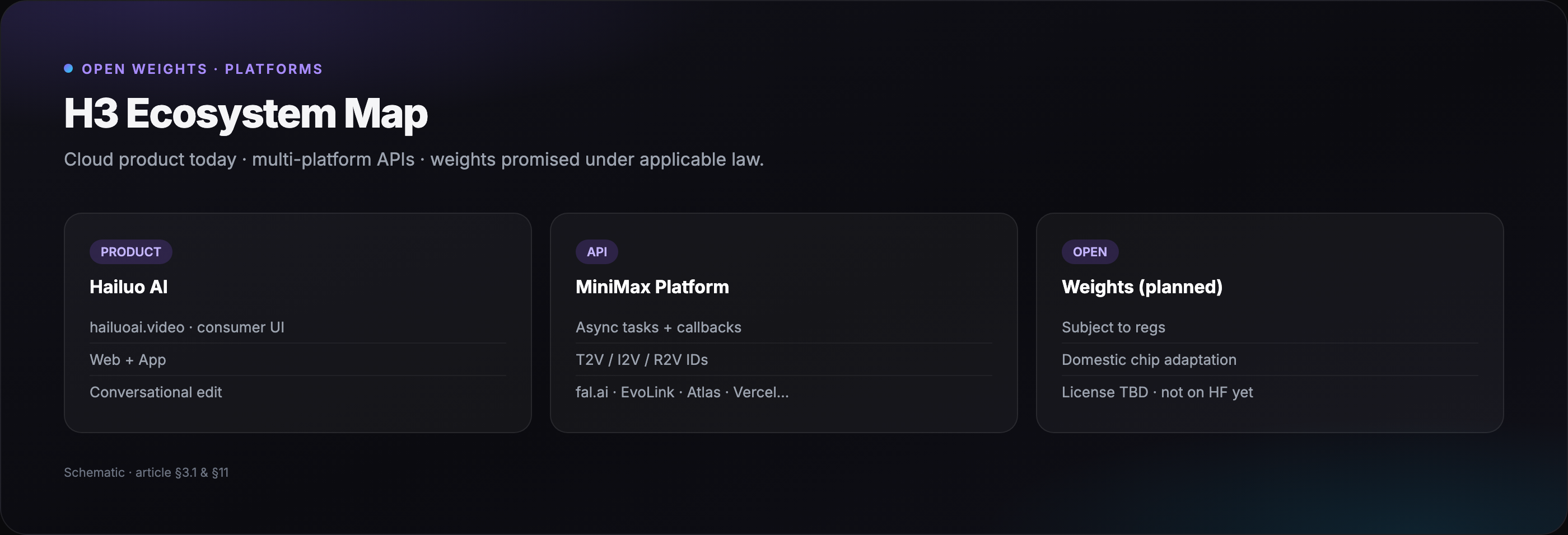
At the product level, H3 reaches users through several main entry points:
- Hailuo AI: A consumer-facing product designed for creators, available via web and mobile app.
- MiniMax Open Platform: An API service built for developers, supporting asynchronous task submission, polling, and webhooks/callbacks.
- minimaxh3.art: A web studio where you can run MiniMax H3 text-to-video and image-to-video (with audio), generate, and export directly in the browser.
In addition, H3 is available on multiple third-party platforms, including fal.ai, Atlas Cloud, EvoLink, Topview, Vercel AI Gateway, and others, allowing developers to integrate H3 capabilities without interacting directly with MiniMax's official API.
3.2 Core Philosophy: From "Task Pipelines" to a "Unified Context"
Traditional video generation workflows typically work like this: use one model for text-to-video, another for style transfer, a third tool for voiceovers or audio, and finally assemble all assets in video editing software. Each step operates independently, and each step loses semantic context from the previous stage.
H3 adopts a fundamentally different design philosophy. It places all inputs—text descriptions, reference images, reference videos, and reference audio—into the exact same context window, enabling the model to holistically understand their relationships. Official documentation calls this capability Contextual Omni Representation.
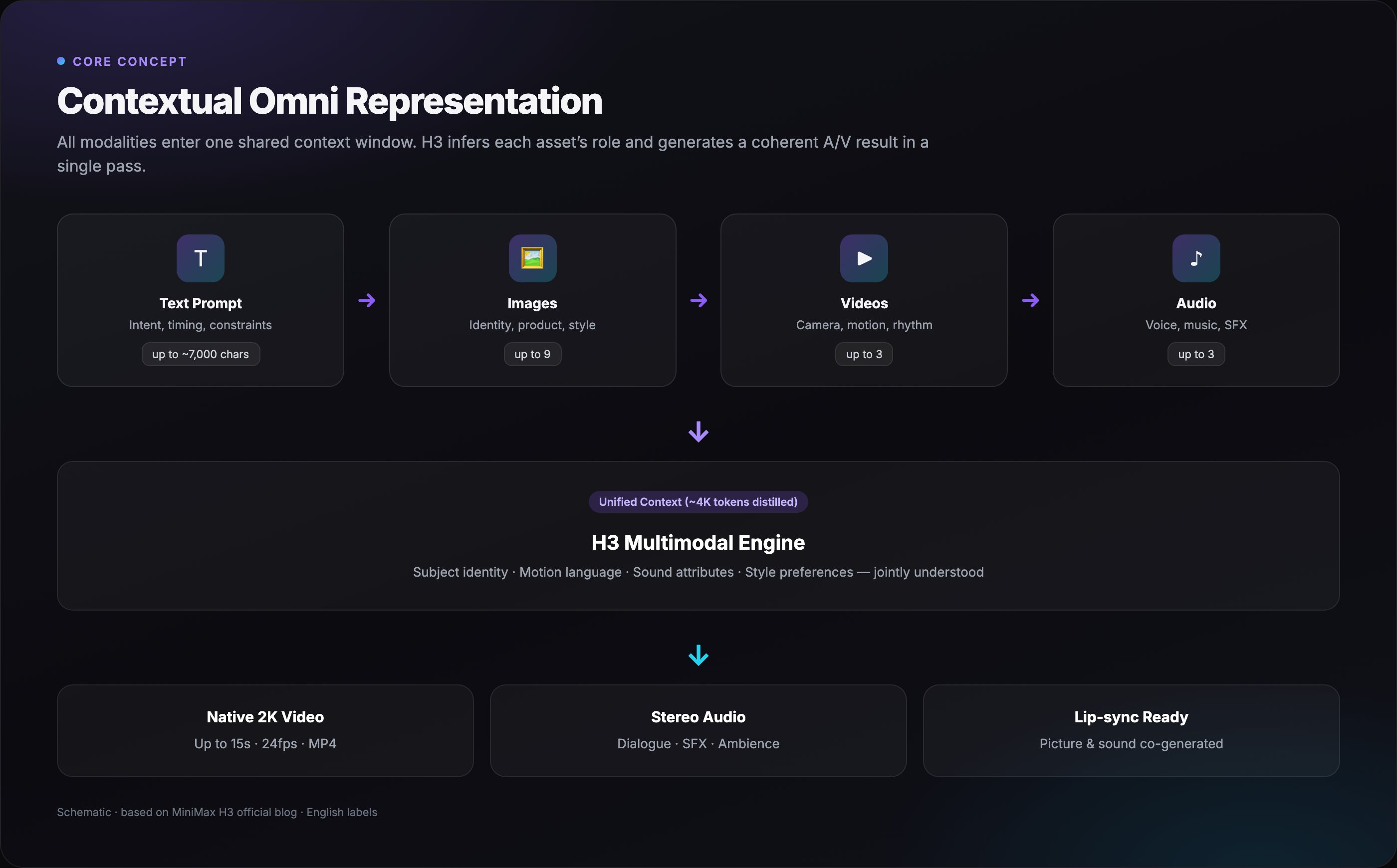
To take a concrete example: you can feed H3 three inputs simultaneously—
- A subject photo (Image 1: character appearance)
- A camera motion clip from a Hitchcock film (Video 1: camera movement)
- A vocal singing track (Audio 3: audio reference)
Then, enter a text prompt: "Place the character from Image 1 on stage, apply the camera movement from Video 1, and have them sing along to Audio 3."


H3 automatically parses these inputs: Image 1 supplies the character identity, Video 1 supplies the camera movement style, and Audio 3 supplies the voice and rhythm. You don't need to invoke three separate models or manually designate that "this image is for character reference, this video is for motion transfer, and this audio is for voice cloning"—the model infers the exact role of each asset directly from the context.
This unified understanding is the key differentiator that sets H3 apart from most competitors.
3.3 Essential Differences from Standard "Text-to-Video"
Most video generation models on the market are essentially text-to-video (T2V) systems retrofitted with extra features (such as image-to-video or basic editing). Their underlying architecture remains designed around generating visuals from textual prompts.
H3, by contrast, functions much more like a multimodal content creation engine. Text is merely one of several input channels, not the sole driving force. Images, video, and audio act as equally weighted conditional inputs, and the model determines each asset's role in the final render based on context.
Consequently, H3 excels in scenarios where you already possess existing assets (product photos, brand footage, promotional audio) and want to remix them into new video content. This is exceptionally common across advertising, e-commerce, and brand marketing—where creators do not start from scratch, but rather build upon established brand assets.
4. Core Specifications
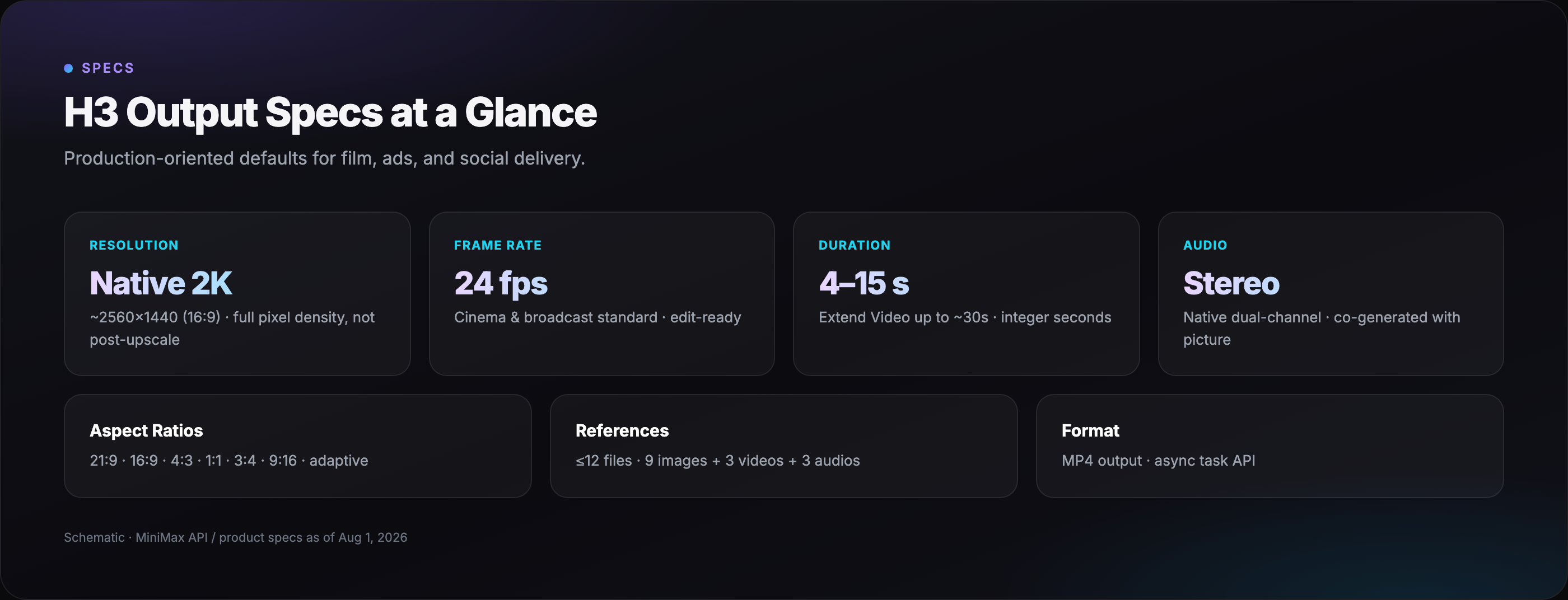
Before diving into the underlying architecture, let's lay out MiniMax H3's core specifications in a single table. These figures are sourced from MiniMax's official launch page and API documentation, current as of August 1, 2026.
4.1 Output Specs
| Parameter | Specification |
|---|---|
| Max Resolution | Native 2K (short edge ~1440px, ~2560×1440 for 16:9) |
| Frame Rate | 24 fps (film and broadcast standard frame rate) |
| Output Duration | 4–15 seconds (set in whole seconds), extendable to ~30s via Extend Video tool |
| Aspect Ratio | 21:9 / 16:9 / 4:3 / 1:1 / 3:4 / 9:16, or adaptive |
| Audio | Native dual-channel stereo (dialogue + sound effects + ambient sound, generated in the same inference pass as video) |
| Output Format | MP4 |
A few noteworthy details:
Native 2K, not upscaled post-generation. MiniMax H3 renders 2K resolution at full pixel density internally, rather than generating low-resolution frames and scaling them up via a standalone super-resolution model. Official sources highlight a technique called In-Context Regeneration: the model first generates a lower-resolution draft, then re-reads the raw multimodal context to perform a high-resolution regeneration pass. This gives fine details—such as small text, logos, and intricate textures—a chance to be restored directly from the original semantic context rather than guessed by an upscaler.
24 fps matches cinematic standards. Choosing 24 fps over 30 fps or 60 fps indicates that MiniMax H3 targets film, TV, and advertising production rather than real-time gaming or interactive applications. Because 24 fps is the standard frame rate across theatrical cinema and streaming platforms worldwide, generated clips can drop directly into post-production workflows without requiring framerate conversion.
15-second single-pass cap. While a single generation maxes out at 15 seconds—sufficient for social media ads, product showcases, and short narrative beats—it cannot cover long takes or continuous storylines. Longer clips require extending the video in chunks using the Extend Video tool. However, each extension triggers a fresh generation pass, meaning cross-segment consistency in character and style must be maintained using reference assets.
4.2 Input Specs
| Parameter | Specification |
|---|---|
| Text Prompt | Max ~7,000 characters |
| Reference Images | Up to 9 images; single file ≤30 MB; dimensions 256–5,760 pixels |
| Reference Videos | Up to 3 clips; 2–15s per clip; single file ≤50 MB; total duration ≤15s |
| Reference Audio | Up to 3 tracks; 2–15s per track; single file ≤15 MB; total duration ≤15s |
| Total Mixed Files | ≤12 files total |
| Max Request Body | 64 MB |
| Audio Constraints | Cannot be used as the sole prompt; must be combined with text, image, or video inputs |
The most striking spec here is the 12 reference file limit. Supporting up to 9 images + 3 videos + 3 audio tracks is exceptionally generous compared to current commercial video models. By comparison, Google Veo 3.1 supports only 3 reference images, and Kling 3.0 Pro's reference limits are noticeably lower than MiniMax H3's[4][9].
However, "more" does not always mean "better." Official samples and community testing show that overloading a request with 12 reference files without giving the model clear role assignments often yields worse results than using 3–5 high-quality references with explicit prompts detailing each asset's purpose. The quality and role distribution of reference assets matter far more than sheer quantity.
4.3 Supported File Formats
| Media Type | Formats |
|---|---|
| Video | H.264, H.265 |
| Image | JPEG, PNG, WebP, HEIC/HEIF |
| Audio | WAV, MP3 |
On the image side, HEIC/HEIF support means iPhone users can upload original photos directly without converting them first. For video, H.264 and H.265 cover the vast majority of standard codecs, though VP9 and AV1 are not supported; videos encoded in those formats must be converted prior to upload.
4.4 Generation Modes
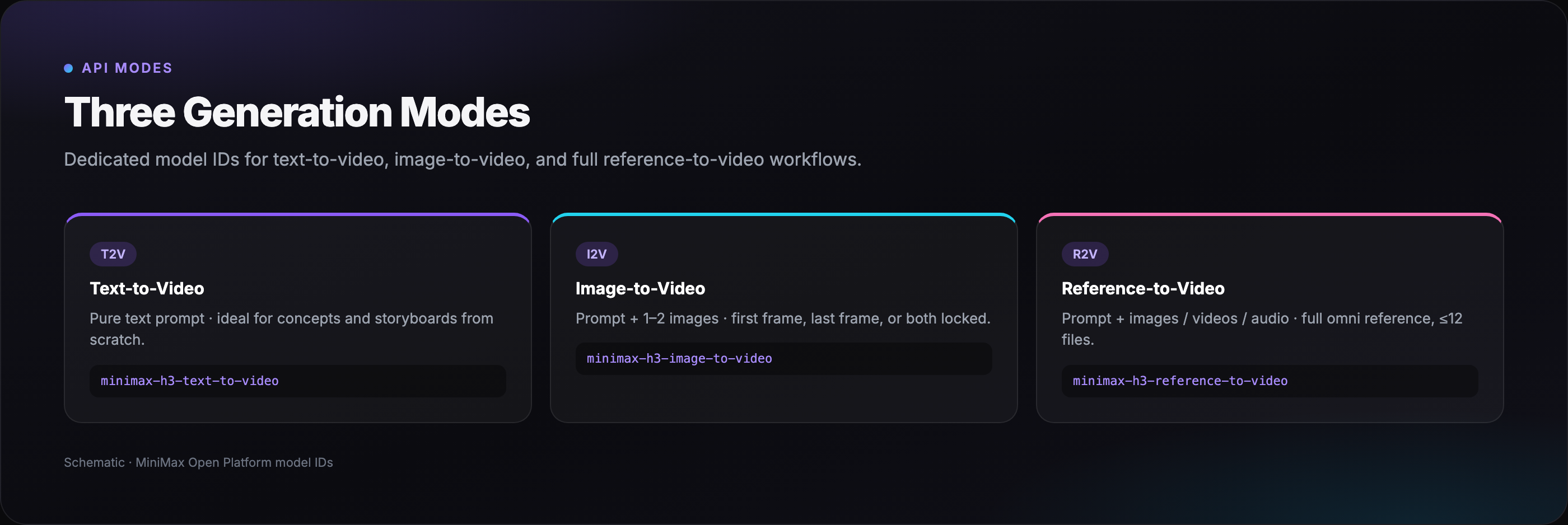
The MiniMax H3 API exposes three generation modes, each mapped to a dedicated model ID:
| Mode | Model ID | Inputs | Description |
|---|---|---|---|
| Text-to-Video (T2V) | minimax-h3-text-to-video | Text prompt only | Generates from scratch; ideal for creative concepts and storyboarding |
| Image-to-Video (I2V) | minimax-h3-image-to-video | Prompt + 1–2 images | Supports keyframing via start frame, end frame, or both simultaneously |
| Reference-to-Video (R2V) | minimax-h3-reference-to-video | Prompt + image/video/audio references | All-in-one reference mode supporting up to 12 input files |
In addition, MiniMax H3 supports instruction-based editing: sending text instructions to edit specific elements in a previously generated video—such as swapping backgrounds, altering outfit colors, or tweaking action pacing—while keeping the rest of the clip untouched. This avoids the frustration of re-generating an entire video just to tweak a single detail, offering huge practical value in iteration-heavy commercial workflows.
4.5 Asynchronous Task Mechanism
The MiniMax H3 API operates asynchronously rather than via a real-time streaming endpoint. The workflow follows three steps:
- Submit task: Send a generation request to receive a job ID.
- Poll status: Query job status periodically (recommended every 10 seconds: Queued → Processing → Completed / Failed).
- Download output: Once completed, fetch the MP4 file from the returned URL.
Alternatively, developers can set up an HTTPS callback via the callback_url parameter. Once the job finishes, the server pushes an event notification directly, eliminating the need to poll.
Note that active jobs cannot currently be canceled once submitted. Failed or rejected requests, however, receive a full refund.
5. Four Core Technical Architectures
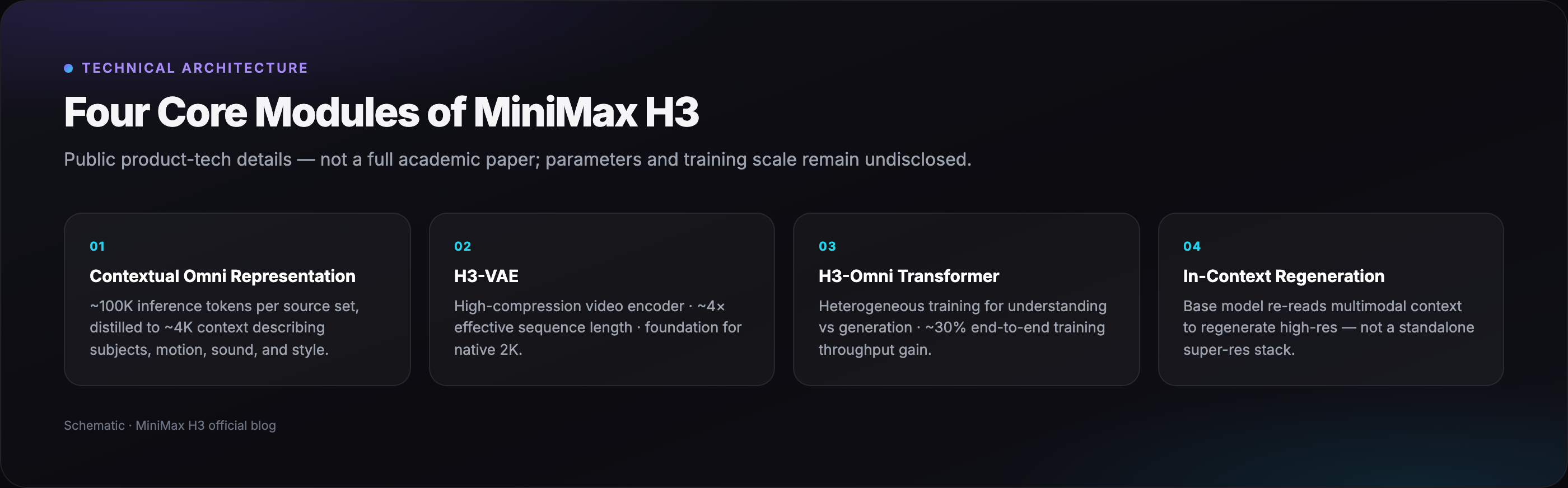
Technical details shared publicly by MiniMax are primarily outlined in product engineering blogs rather than a full academic paper. Key metrics like total parameter count, dataset size, and loss function formulations remain undisclosed. Nevertheless, available details offer a clear blueprint of the system's design. The architecture of MiniMax H3 centers around four core modules.
5.1 Contextual Omni Representation
This represents MiniMax H3's primary architectural philosophy. Traditional video generation models typically isolate tasks into independent subsystems—handling motion transfer, character references, style cues, and audio sync as separate pipelines. MiniMax H3 takes a unified approach, translating input across all modalities into an open-ended language representation.
Under the hood, MiniMax H3 uses a dedicated understanding model and multimodal processing pipeline. When a user submits a collection of reference files (images, video, audio), the system conducts a deep analysis: Who is the subject in this image, what do they look like, and what are they wearing? What camera movement style does this video clip use? What are the timbre, tempo, and emotional tone of this audio track? This diagnostic pass consumes roughly 100,000 inference tokens[1].
Once analyzed, the system compresses this information into a structured contextual description averaging roughly 4,000 tokens. Rather than a surface-level caption like "a woman in a red dress," this description forms a multidimensional representation detailing subject identity, action traits, camera language, acoustic properties, and aesthetic style.
The benefits are clear: during the generation stage, the Transformer only needs to process this condensed contextual description rather than raw multimodal inputs that could span hundreds of thousands of tokens. This drastically reduces inference costs while retaining a deep semantic understanding of the source material.
5.2 H3-VAE
A Variational Autoencoder (VAE) is a foundational component in video generation models, responsible for compressing high-dimensional pixel space into a lower-dimensional latent space. MiniMax overhauled this component, dubbing it H3-VAE.
H3-VAE brings two major improvements:
Enhanced reconstruction quality. Improved latent space learnability allows the downstream generation Transformer to "draw" in latent space more effectively, yielding fewer artifacts when decoded back to pixel space.
High compression ratio. This is H3-VAE's defining feature. MiniMax reports increasing the "effective sequence length" efficiency by roughly 4x over previous architectures[1]. Put simply, encoding a video clip through H3-VAE produces a token sequence only one-fourth the length of prior models. For the same compute budget, the model can synthesize longer video sequences or higher-resolution frames at faster inference speeds.
It is precisely this high compression ratio that allows MiniMax H3 to deliver native 2K outputs while maintaining practical inference costs and generation throughput. Without this foundation, generating native 2K video would be practically infeasible on modern hardware.
That said, MiniMax has not disclosed specific technical details regarding H3-VAE: What are the spatial and temporal compression factors? Does it use discrete tokens? What is the latent channel dimensionality? How are reconstruction and perceptual losses balanced? Answering these questions will require a full technical report.
5.3 H3-Omni Transformer
The Transformer serves as the backbone of MiniMax H3, synthesizing final video frame sequences based on the Contextual Omni Representation and VAE latent variables.
A key innovation in the H3-Omni Transformer is its heterogeneous training architecture for understanding and generation. Multimodal inputs exhibit extreme sequence length variance—a simple text-to-video prompt might require only a few hundred tokens, whereas an all-in-one reference request containing 9 images, 3 videos, and 3 audio tracks can demand hundreds of thousands of tokens. This variance leads to severe training bottlenecks: short-sequence jobs complete early while long-sequence jobs stall, causing imbalanced GPU utilization.
MiniMax resolved this by decoupling compute workloads for "understanding" (analyzing reference assets) and "generation" (synthesizing video frames) at the training execution layer. This decoupling does not necessarily imply two separate neural networks; rather, it likely involves separation in the computation graph, parallelism strategies, or expert routing paths. MiniMax reports that this design improved end-to-end training throughput by nearly 30%[1].
However, note that a "30% boost in training throughput" is an engineering metric, not an output quality metric. While it demonstrates optimized training efficiency at MiniMax, it does not imply that output quality improved by 30% over previous generations.
5.4 In-Context Regeneration
This mechanism is the key technology enabling MiniMax H3's native 2K output and marks a core departure from traditional super-resolution pipelines.
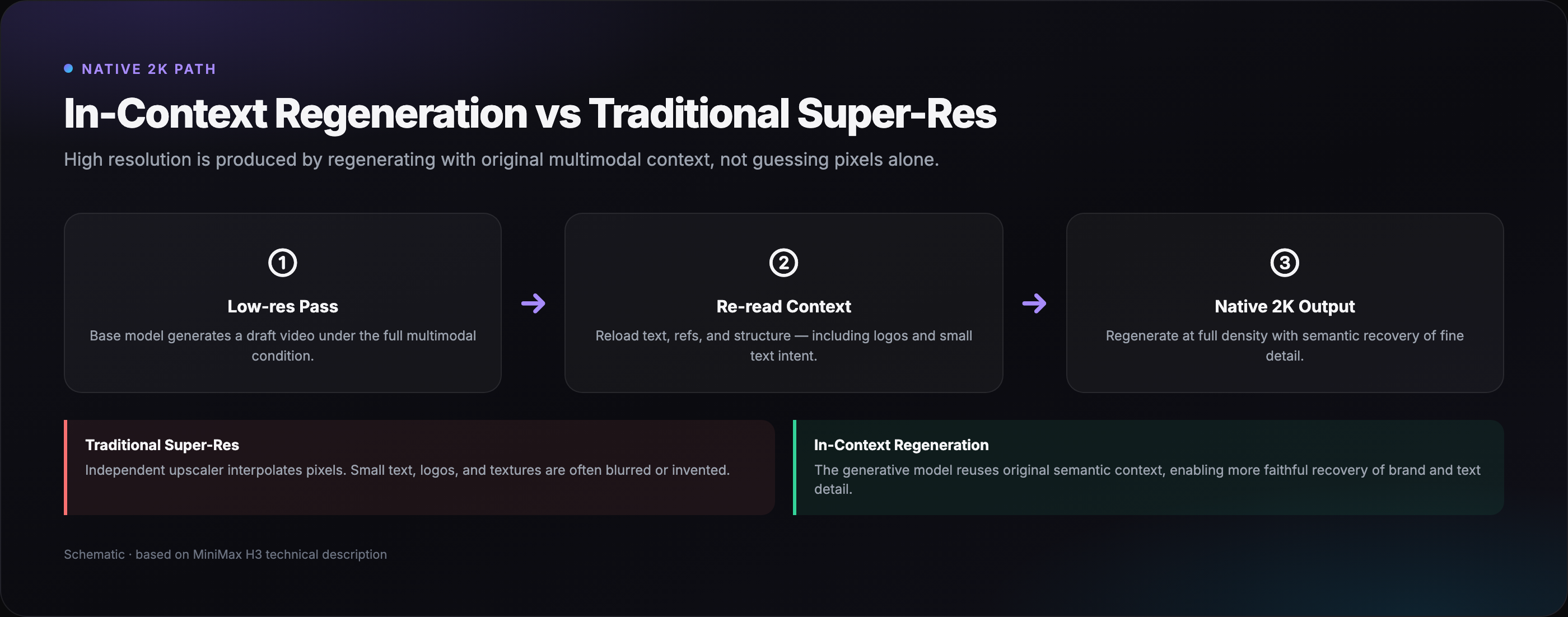
Traditional video upscaling generates a low-resolution video first, then passes it to an independent super-resolution model to upscale frame by frame. Because an upscaler can only "guess" missing details at the pixel level, semantic elements like fine typography, logos, or intricate patterns often end up blurry or distorted.
In-Context Regeneration takes a fundamentally different approach. After generating a low-resolution draft, the foundation model re-reads the original multimodal context (including text prompts, reference images, and video clips) to perform a second, high-resolution generation pass grounded in those semantic details. Because the model retains explicit knowledge of what a logo looks like or what text was requested, it can accurately reconstruct fine details during regeneration rather than guessing through pixel interpolation.
While elegant, this design carries trade-offs. The second generation pass can introduce detail drift—where subtle elements in the high-resolution version diverge from the low-resolution draft. MiniMax has not published ablation studies quantifying the gains of In-Context Regeneration over traditional spatiotemporal super-resolution, so real-world performance must be evaluated on a case-by-case basis.
A note on the core generative paradigm: While these four modules define MiniMax H3's architectural composition, a key detail remains missing: Is MiniMax H3's underlying generative paradigm based on Diffusion, Flow Matching, discrete auto-regression, or a hybrid mechanism? Official documentation highlights H3-VAE and H3-Omni Transformer without defining the underlying mathematical framework. Rigorously speaking, we can only confirm that MiniMax H3 employs a VAE + Transformer architecture; it cannot be definitively categorized as a standard DiT or specific flow model until a comprehensive technical report is released.
6. Deep Dive into Capabilities
Building on the technical foundation covered in previous sections, this section takes a closer look at what MiniMax H3 can do, how well it performs, and where its current boundaries lie.
6.1 Unified Multimodal Understanding and Generation
This is MiniMax H3's core capability—a direct product implementation of the Contextual Omni Representation philosophy emphasized earlier.
In practice, this means you can use natural language to define the role of each reference asset rather than configuring preset templates or fixed parameters. The model automatically infers relationships across context.
MiniMax demonstrated several official use cases. A representative workflow involves uploading a product photo, a brand video, and a background track, then prompting: _"Render the product using the camera movement from the video, with the uploaded audio as background music."_ In a single generation pass, MiniMax H3 completes product rendering, camera movement replication, and audio-visual synchronization without multi-step post-processing. (The Hitchcock dolly zoom example from Section 3.2 is another classic illustration of this capability.)
This capability is particularly valuable for advertising and brand content creation. Brands typically possess extensive media libraries—product photography, video assets, commercial tracks, and model shots. MiniMax H3 accepts these assets directly as reference inputs, allowing creators to describe relationships via text to rapidly generate new video content. This approach is far more efficient than generating from scratch via pure text prompts and offers superior brand consistency.
6.2 Native Audio-Visual Synchronization
Another flagship feature of MiniMax H3 is native dual-channel stereo audio, generated alongside video frames within the exact same inference pass.
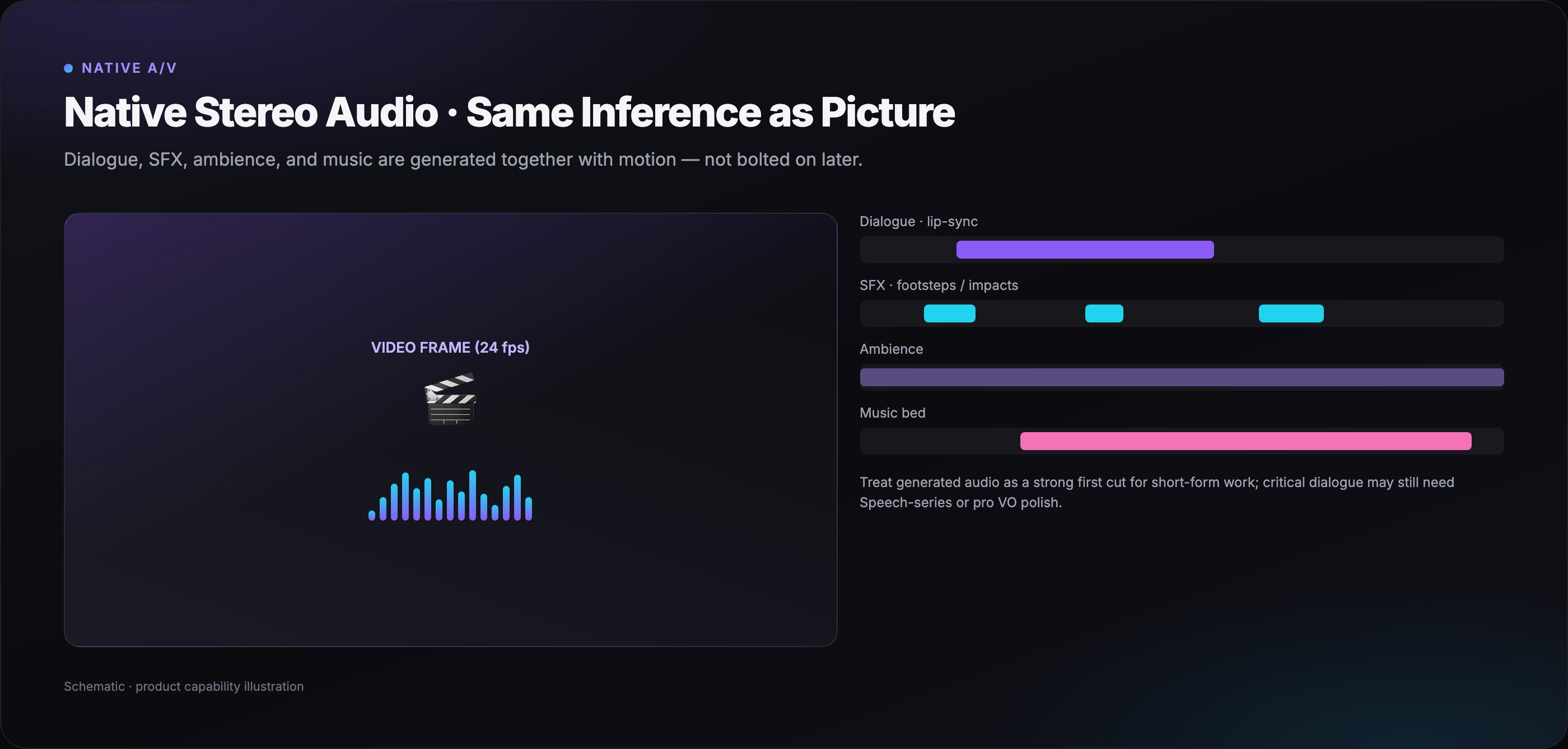

This means generated videos are no longer silent clips. Dialogue, ambient noise, sound effects, and background music are temporally aligned with on-screen action: footstep sounds follow walking cadences, shattering glass audio aligns precisely with impact frames, and lip movements synchronize with spoken dialogue. For short-video workflows, this eliminates manual dubbing, sound mixing, and audio-visual alignment in post-production.
Audio capabilities include:
- Dialogue Generation: Characters speak with lip movements synced to spoken audio.
- Sound Effects (SFX): Footsteps, ambient noise, and impact sounds synchronized with visual actions.
- Music Generation: Background scores and atmospheric melodies.
- Voice Cloning / Audio Transfer: Uploading a reference audio clip enables characters to speak or sing using that specific timbre [9].
However, the term "native audio" should be evaluated realistically. While audio is generated in a single inference step rather than synthesized in post-production, its audio fidelity, pronunciation accuracy, and emotional nuance still lag behind professional voice actors or dedicated text-to-speech models (such as MiniMax's own Speech series). For scenarios requiring premium dialogue, MiniMax H3's audio should be treated as a rough-cut reference track rather than final deliverable audio.
6.3 Precise and Controllable Editing & Reference
MiniMax H3 supports multiple control mechanisms, ranging from coarse-grained to fine-grained:
First-and-Last Frame Control. In image-to-video (I2V) mode, users can supply both initial and final frame images; the model generates a smooth transition between them. This is particularly useful when precise control over start and end states is required, such as specific camera angles for product displays.
Instruction-Based Editing. This is one of MiniMax H3's most valuable features for workflow efficiency, and the core capability driving its #1 ranking on the Artificial Analysis editing leaderboard (Elo ~1130).
Instruction-based editing operates intuitively: describe desired modifications to an existing video using natural language—such as _"Replace the indoor living room background with a sunset beach,"_ _"Change jacket color to white,"_ or _"Add soft ambient wave sounds."_ MiniMax H3 modifies only the specified elements while preserving motion continuity, lighting, and pacing across the rest of the clip.
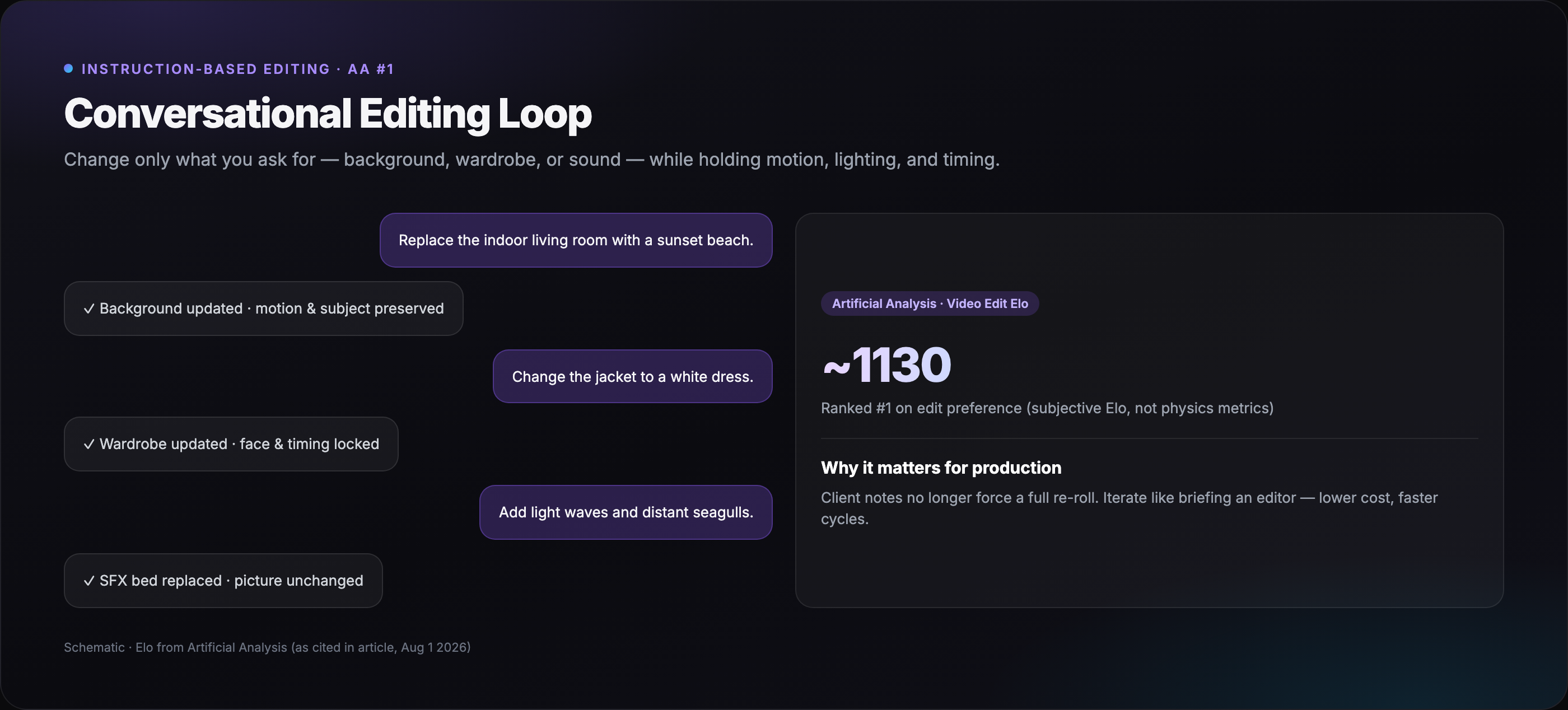
In the Hailuo AI product interface, this workflow manifests as conversational editing—you can issue iterative modification prompts like a chat session, with the model making incremental adjustments based on the previous iteration. For instance, you might start with _"Change background to the beach,"_ follow up with _"Add wave sound effects,"_ and finish with _"Change character dress to white."_ This interactive loop allows creative teams to collaborate with AI much like they would with a video editor, significantly lowering technical barriers.
This resolves a major bottleneck in traditional AI generation workflows: re-rendering an entire video just to adjust a single detail. In commercial workflows where client feedback frequently requests minor tweaks—adjusting clothing colors, swapping backgrounds, or embedding text—instruction-based editing makes iterations fast and cost-effective.
Video-to-Video (V2V) Motion Transfer. Extracts movement patterns and motion dynamics from a reference video and applies them to a new character or scene—such as driving a cartoon character's dance routine using a street dance reference video.
Multi-Reference Locking. Locks character identity, visual style, camera movement, and audio characteristics across multiple reference images and videos to maintain cross-shot consistency. Supporting up to 9 images + 3 videos + 3 audio tracks as reference capacity, this represents a top-tier specification among current commercial models.
6.4 Multi-Shot Storytelling
MiniMax H3 supports multiple shots within a single generation pass while maintaining character and stylistic consistency across cuts. This is vital for short-form narrative content—a 15-second video might feature an opening wide shot, a medium dialogue shot, and a closing close-up. While composition and framing vary per shot, character appearance, attire, and voice remain consistent throughout.
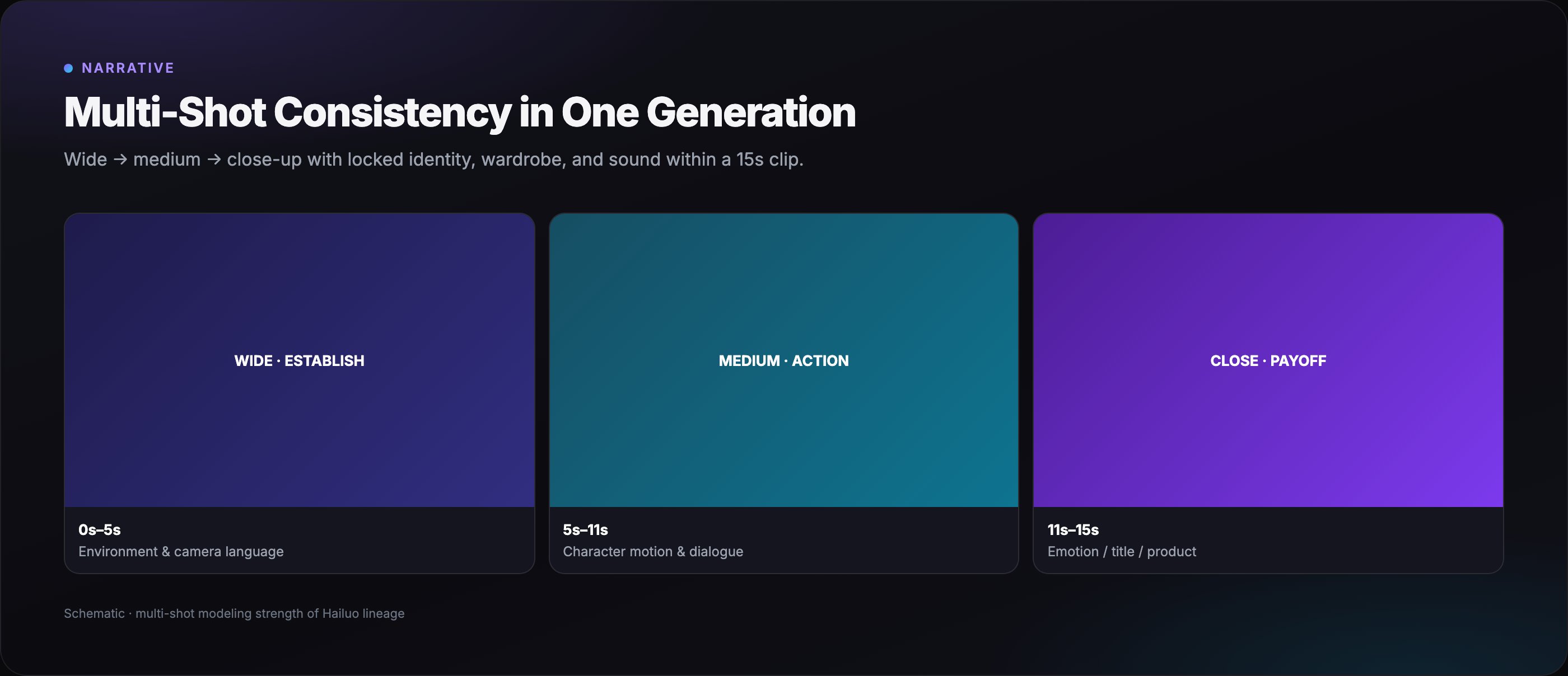
Multi-shot modeling is a traditional hallmark of the Hailuo series [10]. Building on this legacy, MiniMax H3 enhances native multi-shot functionality. Rather than requiring manual shot transition triggers, the model automatically coordinates camera pacing and shot selection based on prompt timing cues and narrative rhythm.
However, the 15-second duration limit means individual shots average only 3–5 seconds. For complex narratives requiring extended takes or frequent cuts, creators must still generate clips in segments and assemble them in video editing software.
Video Extension (Extend Video). If 15 seconds is insufficient, MiniMax H3 offers a video extension feature: appending additional generated footage to extend total duration up to approximately 30 seconds. Each extension requires a new generation task, where the model continues synthesis based on the final frame of the existing clip and original context. While shot transitions across extensions are generally smooth, cross-segment character and style consistency still benefit from reference assets. For requirements exceeding 30 seconds, multi-clip editing and color grading in external software remain recommended.
6.5 Text and Brand Rendering
MiniMax H3 shows noticeable improvements in text rendering, with official claims asserting high-precision rendering of text, logos, and product details [1][6]. Early practical tests indicate that MiniMax H3 handles small, clear logos and main headlines well, accurately generating brand names and simple slogans.
However, expectations should be calibrated realistically: "high precision" represents an upgrade relative to previous-generation models, not pixel-perfect, typography-grade rendering. Scenarios involving dense small text, complex UI interfaces, or multi-line paragraphs remain prone to spelling typos, character distortion, or layout drifting.
Based on official examples, MiniMax H3 performs well in the following text rendering scenarios:
- Product Websites / E-Commerce Pages: Large product names, price tags, and concise button copy.
- Film Opening Titles: Single-line or two-line brand slogans, such as _"STILL MOVING"_ in official samples.
- Motion Posters: Short brand names and core messaging.
However, caution is advised for the following scenarios:
- Dense, small-font explanatory copy.
- Multi-line paragraphs or long sentences.
- Complex UI elements (menus, tables, data charts).
- Non-Latin script rendering accuracy (Chinese, Japanese, Arabic, etc.).
When producing commercial brand assets, treat MiniMax H3's raw output as a draft: essential text overlays and logos should still be audited and refined using post-production software.
Practical tips for text rendering:
- Specify exact required text in prompts, adding explicit constraints like _"must render text accurately without typos."_
- Keep text prompts short and clear, avoiding lengthy sentences.
- Generate multiple variants and select the candidate with the highest typographic accuracy.
6.6 Motion Physics and Spatial-Temporal Consistency
Based on Artificial Analysis blind test evaluations, MiniMax H3's overall motion quality and temporal consistency rank among industry leaders. A fixed 24 fps output guarantees fluid motion across diverse scenarios shown in official demos, including human walking, product rotation, and camera push/pull tracking shots.
However, blind benchmark leaderboards do not isolate granular metrics such as identity drift, limb topology errors, occlusion recovery, 3D geometric stability, or physical conservation laws. The following scenarios remain high-risk edge cases:
- Complex multi-person interactions (e.g., handshakes, hugs, martial arts combat).
- Fine-grained hand-object contact (e.g., writing, playing piano, flipping book pages).
- Specular reflections and transparent media.
- Rapid occlusion and re-emergence.
- Precision mechanical movements.
- Multi-shot causal consistency across cuts.
These challenges are not unique to MiniMax H3, but rather shared limitations across current state-of-the-art video generation models. When deploying MiniMax H3 in commercial pipelines, perform thorough A/B testing on these edge cases rather than relying solely on curated promotional demos.
7. Use Cases and Fit Analysis
MiniMax H3's feature set—multimodal reference inputs, native 2K resolution, native audio, and instruction-based editing—gives it a distinct advantage in specific scenarios while making it less optimal for others. This section ranks use cases by degree of fit to help evaluate whether MiniMax H3 suits your operational requirements.
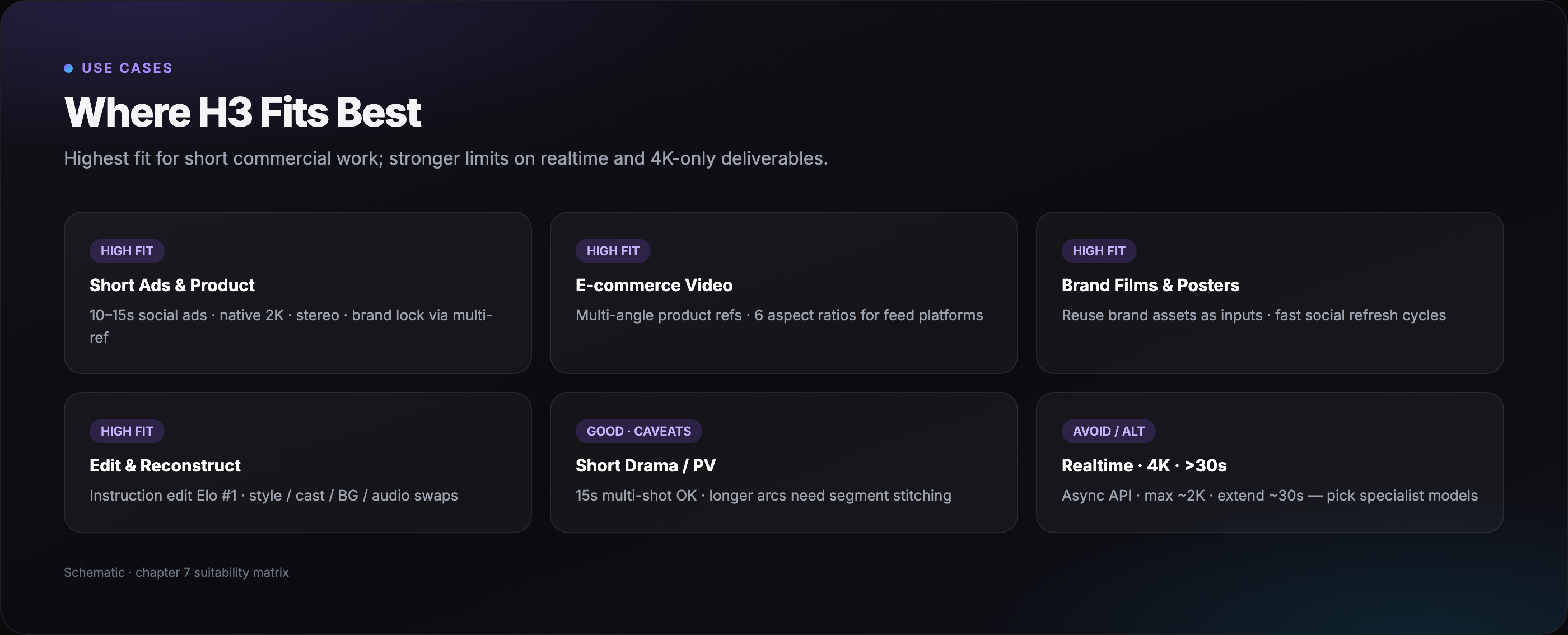
> If you mainly care whether ads, product clips, or vertical shorts can ship today, open minimaxh3.art first: generate a 2K-class clip with audio from a product still or prompt, then use the fit matrix below to refine your workflow.

7.1 High-Fit Scenarios
Short Commercials and Product Videos. This represents MiniMax H3's core application area. Social media ad slots naturally target 10–15 seconds, matching MiniMax H3's optimal output window. Native 2K meets HD broadcast standards, native stereo eliminates dedicated sound design steps, and multi-reference inputs lock product appearance and brand styling. Generating a 10-second 2K ad clip costs approximately 20–30 RMB (~$3–$4 USD, including 2–3 iterations)—a fraction of traditional commercial production costs.
E-Commerce Product Videos. E-commerce video requires accurate product representation, natural motion, and proper aspect ratios. MiniMax H3's multi-reference capability accepts front views, side views, and context imagery simultaneously, ensuring generated assets match real physical products. Support for 6 aspect ratios enables rapid reformatting across ad channels (horizontal feeds, vertical short video, and square product pages).
Brand Films and Motion Posters. Brands usually hold extensive visual repositories. MiniMax H3's omni-reference mode ingests these assets directly, letting creators define asset roles via text prompts to quickly produce branded media. For social media teams needing frequent asset refreshes, this asset-driven workflow is exceptionally valuable.
Editing and Restructuring Existing Video. MiniMax H3's instruction-based editing ranks #1 on the Artificial Analysis leaderboard (~1130 Elo), holding a comfortable lead over runner-up models. For tasks involving style transfers, character swaps, background replacements, or sound insertion on existing footage, MiniMax H3 is a top-tier choice.
7.2 Medium-Fit Scenarios (Feasible with Caveats)
Vertical Short Dramas and Narrative Content. While 15 seconds is brief, it accommodates a compact three-act narrative arch. Multi-shot modeling and character consistency enable seamless multi-camera cuts within a single run. However, extended episodic content requires generating segment by segment and editing externally, relying on reference assets to preserve cross-segment continuity.
Game CG and Character PVs. Stylized generation, character locking, and multi-shot storytelling make MiniMax H3 suited for promotional gaming content. However, for pipelines demanding precise skeletal rigging, physics engine simulation, or high frame rates, MiniMax H3's capabilities remain constrained.
Music Visuals and Performance Clips. Native audio synchronization makes MiniMax H3 well-suited for music-driven media—such as music videos, album teasers, and beat-synced visual loops. The main evaluation focus is verifying whether generated motion and edit cuts align accurately with audio beats.
Pre-visualization and Pitching. Even if final productions use traditional filming, MiniMax H3 helps directors and creative teams visualize camera moves, framing, lighting, and action timing prior to spending production capital. Specifically:
- Ad Agencies: During client pitches, quickly generate 3–5 style variations to illustrate concept execution visually, avoiding misunderstandings from text-only decks.
- Directors / DPs: During storyboarding, test camera motion setups (dolly, orbit, handheld, Steadicam) to evaluate visual storytelling before shooting.
- Marketing Teams: Generate multiple ad variants for A/B testing to measure how different visual treatments, talent, or product placements impact conversion rates.
Film Opening and Closing Titles. MiniMax H3's combination of native 2K, stereo sound, and text rendering makes it effective for title sequences and trailer assets. Official samples showcase title bumpers featuring opening camera moves, character entrances, text fade-ins, and sound effect timing generated in a single pass. For indie filmmakers and content creators, this reduces reliance on expensive compositing software.
Game UI Animations and Interface Demos. MiniMax H3 maintains legible rendering for menus, HUD elements, and text overlays, making it suitable for UI motion design, character select screen concepts, and in-game cutscene mockups. Developers can rapidly convert static UI mockups into dynamic video prototypes for internal reviews or user testing.
7.3 Low-Fit Scenarios (Avoid or Use Alternatives)
Real-Time Streaming and Interactive Digital Humans. MiniMax H3 provides asynchronous API endpoints without streaming or real-time inference. Generation latencies range from tens of seconds to several minutes, making it unsuitable for live interactive applications. Real-time digital human workflows require specialized low-latency real-time models.
Long-Form Continuous Narratives (>30 Seconds). With a single-pass limit of 15 seconds and max video extension around 30 seconds, MiniMax H3 cannot natively generate long single takes or episodic content. For long-form requirements, solutions like Seedance 2.5 (30-second base clips with multi-round extensions up to several minutes) or Kling 3.0 multi-shot setups are better suited.
4K or Higher Resolution Deliverables. MiniMax H3 caps out at native 2K resolution (~1440p). For production workflows requiring 4K deliverables (e.g., large commercial displays, theatrical projection), MiniMax H3 falls short. Kling 3.0 (native 4K) or Veo 3.1 (4K up to 8 seconds) serve as suitable alternatives.
High-Compliance Scenarios with IP Sensitivity. Generating celebrity likenesses, voice clones, protected IP, or branded assets involves right of publicity, copyright, and audio rights considerations. The Hailuo platform faces ongoing copyright litigation from rightsholders like Disney and Universal (see Section 12.3). Before deploying MiniMax H3 for sensitive commercial assets, ensure explicit licensing rights are secured and comprehensive audit trails are maintained.
8. Pricing and Cost
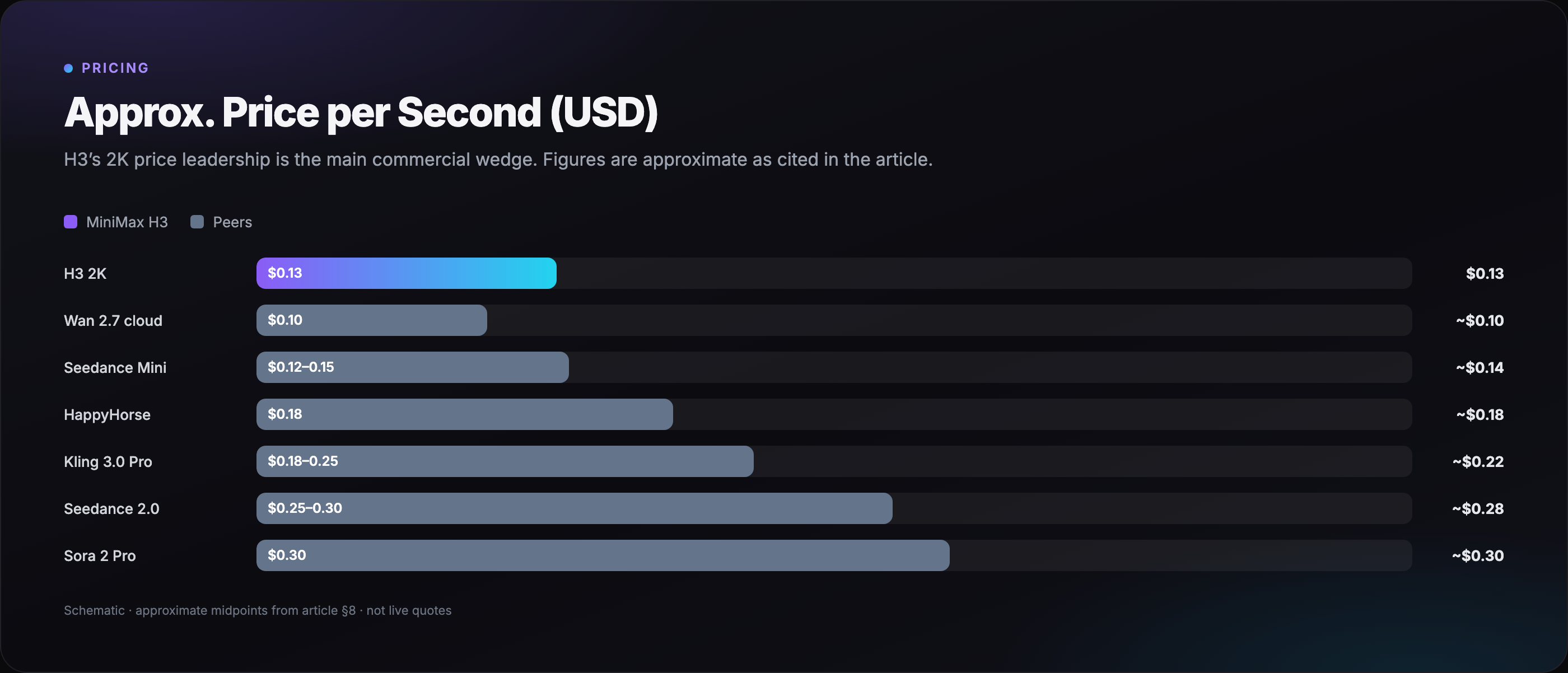
One of the main reasons H3 quickly generated buzz following its release is its aggressive pricing strategy. Official statements explicitly noted that its 2K generation price is "less than one-third that of mainstream models" [1]. Early testers reported around $1 for a 15-second 2K clip (compared to roughly $4 for Seedance at 1080p for the same length) [5], and cross-validation across third-party platforms has largely confirmed these figures [8][9].
8.1 Official Pricing (MiniMax Open Platform)
| Tier | Price | Notes |
|---|---|---|
| 2K (Default) | $0.13/sec (~¥0.80/sec) | Primary featured tier |
| 768p | $0.09/sec (~¥0.50/sec) | Limited rollout status at launch |
Billing is based on output video duration (per second), with full refunds for failed or rejected generation tasks.
8.2 Additional Fees for Reference Assets
| Asset Type | Cost |
|---|---|
| Reference Audio | Free (no charge) |
| Reference Images (First 5) | Free |
| Reference Images (6th onward) | $0.04 per image (~¥0.20/image) |
| Reference Video | Billed based on output resolution and input video duration |
The pricing logic here is straightforward: audio and basic images are free, encouraging users to leverage reference assets to boost generation quality. Video references incur extra charges based on input duration because they consume significantly more compute resources.
8.3 Third-Party Platform Pricing
H3 is available across several third-party platforms, with slight variations in pricing:
| Platform | 2K Price | Notes |
|---|---|---|
| EvoLink | $0.130/sec (8.84 cr/sec) | Matches official pricing |
| fal.ai | ~$0.13/sec | Roughly matches official pricing |
| Atlas Cloud | Coming soon | Price TBD |
| Vercel AI Gateway | Pay-as-you-go | Price TBD |
Pricing on third-party platforms generally matches official rates or carries a slight premium, while offering more convenient integration pathways and unified API formats.
8.4 Estimated Real-World Costs
For the most common usage scenarios, estimated costs are as follows:
| Scenario | Specs | Estimated Cost |
|---|---|---|
| Short T2V Test | T2V, 5s @ 2K | $0.65 (~¥4.5) |
| Full-Length Video | T2V, 15s @ 2K | $1.95 (~¥13.5) |
| Reference Video Test | R2V, 5s output + 3s reference input | $1.04 (~¥7.2) |
| 10s Ad Clip (with 2–3 iterations) | T2V or I2V, 10s × 3 | ~¥20–30 RMB |
| 1-Minute 2K Pure Generation | 4 × 15s | $7.80 (~¥54) |
8.5 Price Comparison with Competitors
| Model | Approx. Price | Relative to H3 |
|---|---|---|
| MiniMax H3 2K | $0.13/sec | — |
| Seedance 2.0 Standard | $0.25–0.30/sec | ~2–3× H3 |
| Seedance 2.0 Mini | $0.12–0.15/sec | Close to H3, but capped at 720p |
| Kling 3.0 Pro 1080p | $0.18–0.25/sec | Higher than H3 |
| Veo 3.1 | Tiered pricing (4s/6s/8s) | Competitive for short durations; costs escalate for longer clips |
| Wan 2.7 (Cloud) | ~$0.10/sec | Lower than H3, but capped at 1080p |
| Wan 2.7 (Self-Hosted) | Hardware costs only | Zero API fees |
Key takeaways:
H3’s cost performance edge is most pronounced at 2K resolution. When generating at 2K, H3 costs roughly one-third to one-half as much as Seedance 2.0 Standard without sacrificing Elo ranking.
Competition is much tighter at lower resolutions (768p). Models like Seedance 2.0 Mini and the Wan series offer similar or lower prices at lower resolution tiers. Here, H3's price advantage shrinks, making quality and feature set the primary deciding factors.
Self-hosting is the ultimate answer for cost efficiency. If MiniMax releases open weights as planned and H3 can run on consumer GPUs (a point that remains entirely unconfirmed), self-hosting would eliminate API fees altogether. However, the timeline for open weights, licensing terms, and hardware requirements remain unknown.
9. Comprehensive Benchmark Comparison
This is the most information-dense section of this analysis. We compare H3 side-by-side against all major market competitors, covering technical specs, feature capabilities, pricing, Elo rankings, and ideal use cases.
9.1 Overview Comparison Table
We begin with a comprehensive comparison across two dimensions: core specifications and capability/pricing.
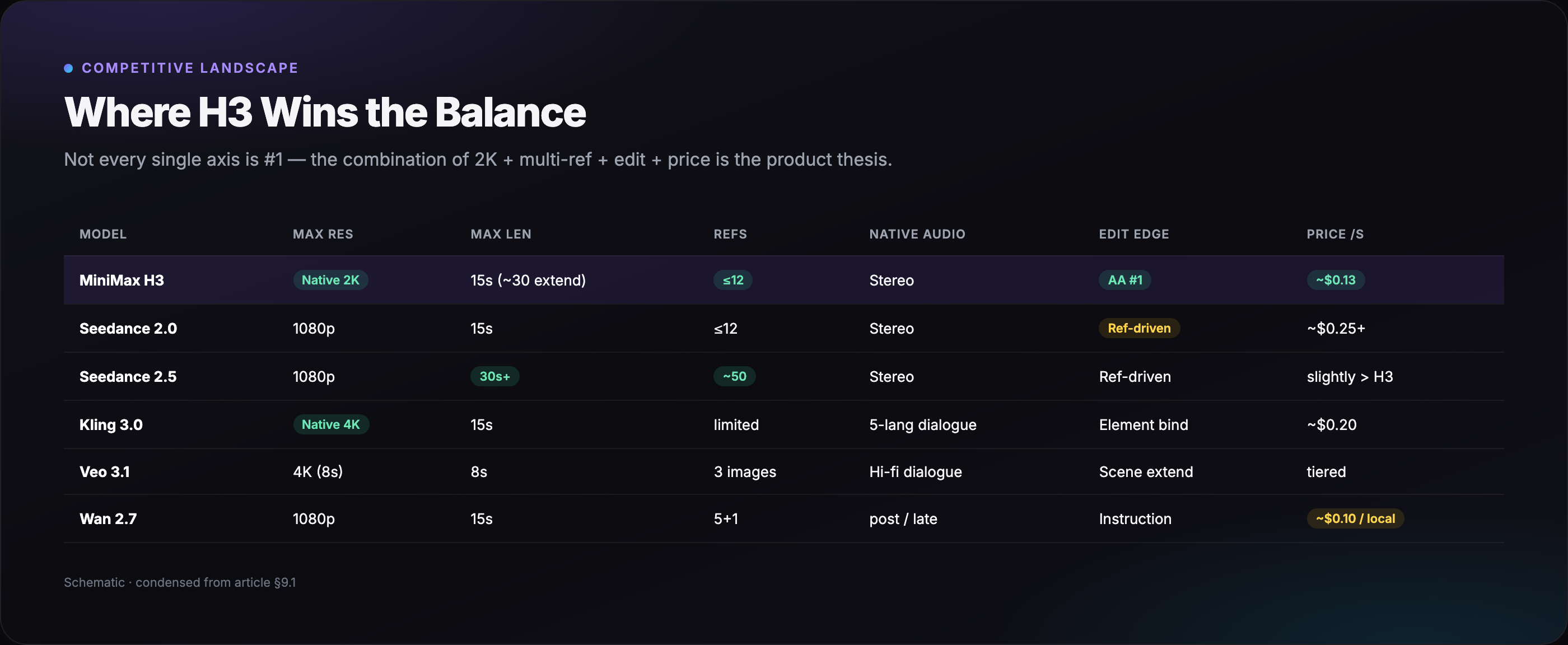
Core Specifications:
| Dimension | H3 | Seed 2.0 | Seed 2.0 Mini | Seed 2.5 | HappyHorse | Wan 2.7 | Kling 3.0 | Veo 3.1 | Sora 2 Pro |
|---|---|---|---|---|---|---|---|---|---|
| Provider | MiniMax | ByteDance | ByteDance | ByteDance | Alibaba ATH | Alibaba Tongyi | Kuaishou | OpenAI | |
| Max Resolution | Native 2K | 1080p | 720p | 1080p | 1080p | 1080p | Native 4K | 4K (8s only) | 1080p |
| Max Duration | 15s | 15s | 15s | 30s | 15s | 15s | 15s | 8s | 20s |
| Native Audio | Stereo | Stereo | Yes | Stereo | Multilingual lip-sync | Post-process support | 5-language dialogue | Dialogue + SFX | Synced audio |
| Max Reference Inputs | ≤12 | ≤12 | Simplified | ~50 | ≤9 images | 5+1 | — | 3 images | — |
| Open Source | Coming soon | Closed | Closed | Closed | Unannounced | Apache 2.0 | Closed | Closed | API retiring Sept |
Capabilities and Pricing:
| Dimension | H3 | Seed 2.0 | Seed 2.5 | HappyHorse | Wan 2.7 | Kling 3.0 | Veo 3.1 | Sora 2 Pro |
|---|---|---|---|---|---|---|---|---|
| Editing Capability | Instruction-based (AA #1) | Reference-driven | Reference-driven | Character locking | Instruction edit | Element binding | Scene extension | Video editing |
| Core Advantage | 2K + editing + value | Multi-ref + narrative | Extended duration | Multilingual lip-sync | Open-source deployment | 4K + multi-shot | Physical realism | ChatGPT integration |
| Pricing (/sec) | ~$0.13 | ~$0.25 | Slightly above H3 | ~$0.18 | ~$0.10 | ~$0.20 | Tiered | ~$0.30 |
These two tables highlight H3's clear positioning: it achieves the best overall balance between 2K resolution, multimodal reference flexibility, editing capabilities, and pricing. While it doesn't top every individual metric—Kling 3.0 offers 4K, Seedance 2.5 supports longer clip lengths, and Wan 2.7 allows self-hosting—H3 delivers the most compelling overall package when factoring in capability and value.
Below, we examine how H3 stacks up against each major competitor.
9.2 H3 vs. Seedance 2.0
This is the most widely discussed head-to-head comparison post-launch. While the two models share similar specs on paper, they exhibit distinct operational characteristics.
Specification Comparison:
| Dimension | MiniMax H3 | Seedance 2.0 |
|---|---|---|
| Max Resolution | Native 2K (~2560×1440) | 480p/720p/1080p (native) |
| Max Duration | 15s (Extend ~30s) | 15s |
| Reference Inputs | ≤12 files | ≤12 files |
| Audio | Dual-channel stereo | Dual-channel stereo |
| Editing Method | Instruction-based editing | Reference-driven |
| Price (2K) | ~$0.13/sec | ~$0.25–0.30/sec (1080p) |
| Open Source | Coming soon | Closed source |
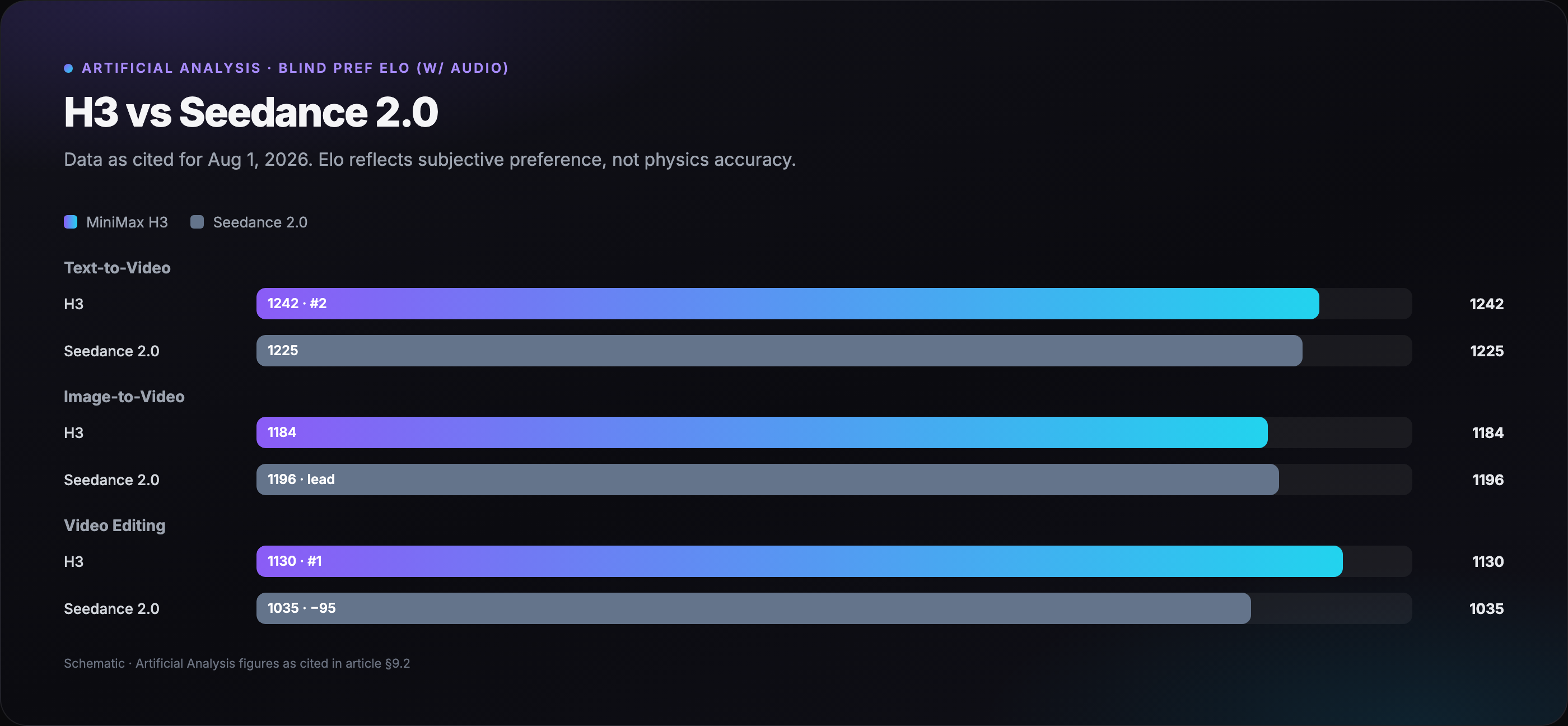
Elo Ranking Comparison (Artificial Analysis audio-enabled blind arena, Aug 1, 2026 data) [3]:
| Task | H3 | Seedance 2.0 |
|---|---|---|
| Text-to-Video (T2V) | 1242 (#2) | 1225 |
| Image-to-Video (I2V) | 1184 | 1196 (+12 ahead) |
| Video Editing | 1130 (#1) | 1035 (95-point gap) |
Key Differences:
H3’s margin over Seedance 2.0 is concentrated in editing rather than across all generation modes. The 95-point Elo lead in video editing represents a substantial gap. In text-to-video (T2V), H3 holds a slight 17-point lead within a tight confidence interval near the top spot. In image-to-video (I2V), Seedance retains a 12-point advantage.
User sentiment from real-world testing can be summarized as: H3 excels at making clips look like polished finished products, whereas Seedance is better at strictly executing specific spatial instructions. H3 delivers stronger overall cinematic polish, visual consistency, and production feel, while Seedance stands out in precise prompt adherence and fluid motion dynamics.
On price, H3's 2K tier (~$0.13/sec) costs roughly one-third to one-half as much as Seedance 2.0 at 1080p, delivering a decisive cost advantage.
Verdict: Choose H3 for short commercial clips, e-commerce ads, and brand assets. Choose Seedance 2.0 for flexible multi-reference setups, music-driven pacing, and multi-shot narrative sequencing. They are complementary and work exceptionally well when combined in the same production pipeline.
9.3 H3 vs. Seedance 2.0 Mini / Fast
Seedance 2.0's lightweight variant, targeted at high-volume iteration and cost-sensitive workloads.
| Dimension | MiniMax H3 | Seedance 2.0 Mini |
|---|---|---|
| Max Resolution | Native 2K | Capped at 720p |
| Pricing | ~$0.13/sec | ~$0.12–0.15/sec |
| Quality | Full-featured | Slightly compromised |
| Speed | Standard | Faster |
While priced similarly, H3 provides nearly triple the resolution of Seedance Mini. Seedance Mini's primary advantage lies in faster generation speed, making it well-suited for rapid prototyping and high-volume preliminary drafting.
Verdict: Use Seedance Mini for storyboarding, drafting, and rapid iteration; use H3 for fine-grained editing and final delivery.
9.4 H3 vs. Seedance 2.5
Seedance 2.5 is ByteDance's mid-2026 update. Its core selling points are extended duration and high-volume reference inputs, directly addressing H3's 15-second single-pass clip constraint.
| Dimension | MiniMax H3 | Seedance 2.5 |
|---|---|---|
| Max Resolution | Native 2K | 1080p |
| Max Single-Pass Duration | 15s (Extend ~30s) | 30s |
| Multi-Turn Extension | Manual clip-by-clip | Multi-turn extension up to several minutes |
| Max Reference Inputs | ≤12 files (9 img + 3 vid + 3 aud) | ~50 files |
| Audio | Dual-channel stereo | Dual-channel stereo |
| Pricing | ~$0.13/sec | Slightly higher than H3 |
Seedance 2.5’s core strengths are duration and reference scalability. Its native 30-second output combined with multi-turn extensions up to several minutes enables users to generate complete short films, product videos, or continuous narrative arcs without manual stitching in NLE editing software. Its 50-file reference cap far exceeds H3’s 12-file limit, making it ideal for asset-heavy projects that require extensive brand libraries, multi-character setups, and complex scene context.
H3 retains the edge in resolution (2K vs. 1080p), lower pricing, and superior video editing performance (Elo 1130). For short-form content under 15 seconds, H3 delivers better overall value and quality.
The relationship is complementary rather than competitive: H3 is built for efficient, highly precise, cost-effective commercial clips, while Seedance 2.5 shines in longer narrative storytelling with heavy reference dependency. A practical workflow is to leverage H3 for short cuts and precise shot edits, and Seedance 2.5 for long-take scene extensions.
9.5 H3 vs. Kling 3.0 (Kuaishou)
Kling 3.0 is Kuaishou's flagship video model, renowned for native 4K output, multi-shot composition, and cinematic texture.
| Dimension | MiniMax H3 | Kling 3.0 |
|---|---|---|
| Max Resolution | Native 2K | Native 4K |
| Max Duration | 15s | 15s |
| Multi-Shot Capability | Supported | Strong (up to ~6 camera shots) |
| Audio | Stereo | 5-language dialogue + lip-sync |
| Multimodal Reference | 9 img + 3 vid + 3 aud (≤12) | Relatively limited |
| Editing Capability | Instruction-based (AA #1) | Element/character binding |
| Pricing | ~$0.13/sec | ~$0.18–0.25/sec |
| AA Editing Elo | 1130 (#1) | ~1000 |
Kling 3.0’s core strengths are its native 4K resolution and advanced multi-shot camera orchestration. In scenarios demanding ultra-high display fidelity (e.g., large-screen exhibits, theatrical content) or multi-character cinematic storytelling, Kling is hard to match.
H3's advantages lie in its multimodal reference flexibility, instruction-based video editing, and competitive pricing. For workflows requiring multi-asset composition and iterative video modification, H3's 12-file input cap and editing precision surpass Kling's current feature set.
Verdict: Choose Kling for native 4K display and complex multi-shot cinematic sequencing; choose H3 for multimodal reference conditioning, iterative video editing, and superior cost-efficiency.
9.6 H3 vs. Google Veo 3.1
Veo 3.1 is Google's flagship video model, recognized for physical realism and high-fidelity audio generation.
| Dimension | MiniMax H3 | Veo 3.1 |
|---|---|---|
| Max Resolution | Native 2K | 4K (8s only) |
| Max Duration | 15s | 8s (standard single-pass) |
| Reference Inputs | 9 img + 3 vid + 3 aud (≤12) | 3 reference images |
| Audio | Stereo | 48kHz high-fidelity dialogue |
| Physical Realism | Top-tier | Industry-leading |
| Pricing | ~$0.13/sec | Tiered (4s / 6s / 8s) |
Veo 3.1's core strengths are photorealistic motion physics and pristine audio fidelity. When rendering photorealistic product close-ups, complex natural dynamics, or fine human skin textures, Veo sets an industry benchmark. Its 48kHz dialogue generation is also noticeably superior to most competitors.
H3 counters with longer clip durations, broader multimodal reference support, and significantly lower costs. Veo's standard output is capped at 8 seconds with support for only 3 reference images, which constrains multi-asset composite workflows.
Verdict: Choose Veo for photorealism and studio-grade dialogue; choose H3 for longer clip generation, multimodal conditioning, and value.
9.7 H3 vs. HappyHorse 1.1 (Alibaba ATH)
HappyHorse is Alibaba's specialized video model, keying on multilingual lip-sync and character persistence.
| Dimension | MiniMax H3 | HappyHorse 1.1 |
|---|---|---|
| Max Resolution | Native 2K | 1080p |
| Max Duration | 15s | 15s |
| Multilingual Lip-Sync | Yes (primarily EN/ZH) | Strong (~7 languages) |
| Character Consistency | Cross-shot | Strong (up to 9 subject locks) |
| Multimodal Reference | 9 img + 3 vid + 3 aud (≤12) | ≤9 images (R2V) |
| Editing Capability | Instruction-based editing | Character/scene editing |
| Pricing | ~$0.13/sec | ~$0.18/sec |
HappyHorse’s standout feature is multilingual lip-sync fidelity. For global advertising or cross-border marketing campaigns requiring spoken dialog across multiple languages, HappyHorse provides top-notch lip-sync accuracy. Its capability to lock up to 9 character identities also makes it well-suited for ensemble narrative scenes.
H3 stands out with comprehensive multimodal input conditioning, superior video editing capabilities, and lower API pricing. HappyHorse's reference inputs are limited primarily to images (R2V), lacking support for video and audio references. H3's Contextual Omni Representation allows concurrent image, video, and audio conditioning for broader creative control.
Verdict: Choose HappyHorse for multi-speaker lip-sync localization and character locking; choose H3 for multimodal reference flexibility, video editing, and cost performance.
9.8 H3 vs. Wan 2.1/2.7 (Alibaba Tongyi Wanxiang)
The Wan series represents Alibaba's open-weights video models, distinguished by an Apache 2.0 license and self-hosting capabilities.
| Dimension | MiniMax H3 | Wan 2.7 |
|---|---|---|
| Max Resolution | Native 2K | 1080p |
| Max Duration | 15s | 15s |
| Audio | Native stereo | Supported in later revisions |
| Open Source | Coming soon | Yes (Apache 2.0) |
| Self-Hosting | Pending weight release | Supported |
| Cloud API Pricing | ~$0.13/sec | ~$0.10/sec |
| Out-of-the-Box UX | Turnkey API + web UI | Requires deployment/tuning |
The core strength of the Wan series lies in its open-source ecosystem and self-hosting flexibility. Under the Apache 2.0 license, enterprise teams can modify, fine-tune, and deploy models locally without recurring API fees or data privacy concerns. For teams requiring on-premises deployment or custom research pipelines, Wan is an ideal candidate.
H3's edge is its turnkey commercial user experience. MiniMax offers fully managed cloud APIs, Web UI, third-party integrations, and async task orchestration. Developers do not need to manage GPU infrastructure, model orchestration, or inference acceleration. For commercial teams targeting fast time-to-market, H3 significantly reduces engineering overhead.
Verdict: Choose Wan for self-hosted deployment, open-source customization, and fine-tuning research; choose H3 for managed API integration and turnkey commercial production.
9.9 H3 vs. Sora 2 Pro (OpenAI)
Sora was OpenAI's video generation model, noted for extended durations and integration into OpenAI's ecosystem.
| Dimension | MiniMax H3 | Sora 2 Pro |
|---|---|---|
| Max Resolution | Native 2K | 1920×1080 |
| Max Duration | 15s (Extend ~30s) | 20s |
| Multimodal Reference | 9 img + 3 vid + 3 aud (≤12) | Image conditioning & video editing |
| Audio | Native stereo | Synced audio |
| Platform Integration | Hailuo AI + API | ChatGPT integration |
| Pricing | ~$0.13/sec | ~$0.30/sec |
Note, however: OpenAI sunset Sora's web and app experiences in April 2026, with API retirement scheduled for September 2026 [4]. Consequently, Sora is no longer a viable long-term option for production video pipelines.
Verdict: Existing Sora users should migrate as soon as possible. For new projects, H3 provides a more sustainable, affordable, and feature-rich alternative [4].
9.10 Brief Note on Historical Research Models
For completeness, we briefly highlight several historically significant research models:
- Imagen Video (Google, 2022): A cascaded video diffusion architecture representative of early 7-stage super-resolution pipelines. Generated 1280×768 resolution, 5.3-second clips at 24 fps without audio—primarily of academic interest today.
- Phenaki (Google, 2022): Variable-length video generation driven by time-variable text prompts. Pioneered the C-ViViT discrete video tokenizer and bidirectional masked Transformer. While lower in resolution, it introduced prompt-over-time control.
- Make-A-Video (Meta, 2022): Pioneered transferring spatial semantics from text-to-image models while learning temporal motion from unlabeled video data.
While these foundational models played pivotal roles in generative video history, they should not be directly benchmarked against 2026 commercial production models.
10. Prompting Best Practices
MiniMax H3 supports prompts up to 7,000 characters [9], far exceeding most competitors. Both official examples and community benchmarks show that structured, timeline-based long prompts perform far better than short, single-sentence descriptions [1][6][10]. The key mindset when prompting H3 is to write your prompt as a "production spec sheet" rather than a simple "scene description."
10.1 Core Principles
- Assign explicit roles to every reference asset. Don't make the model guess what an image is for. Explicitly state: "Image 1 provides product appearance, Image 2 provides model facial features, Video 1 provides camera movement, Audio 3 provides vocal track."
- Use timestamps to control pacing. Even for short clips, include time markers like
[0s-3s],[3s-8s], etc. Empirical tests show that timestamped prompts dramatically improve pacing control. - Separate visual and audio instructions. Because audio and visuals are generated in a single pass, mixing them together can confuse the model.
- Explicitly specify any text that needs to be legible. If you want a brand name or slogan in the video, spell it out fully in the prompt and add constraints like "must be rendered accurately without typos or extra text." Otherwise, the model may output garbled text or visual artifacts.
- Define explicit locks and negative constraints. Constraints such as "keep clothing unchanged," "no subtitles," or "no watermarks" effectively reduce visual drift and unintended artifacts.
- Lean into long, structured prompts. Official showcase examples are consistently long and structured; short, vague prompts yield noticeably inferior results.
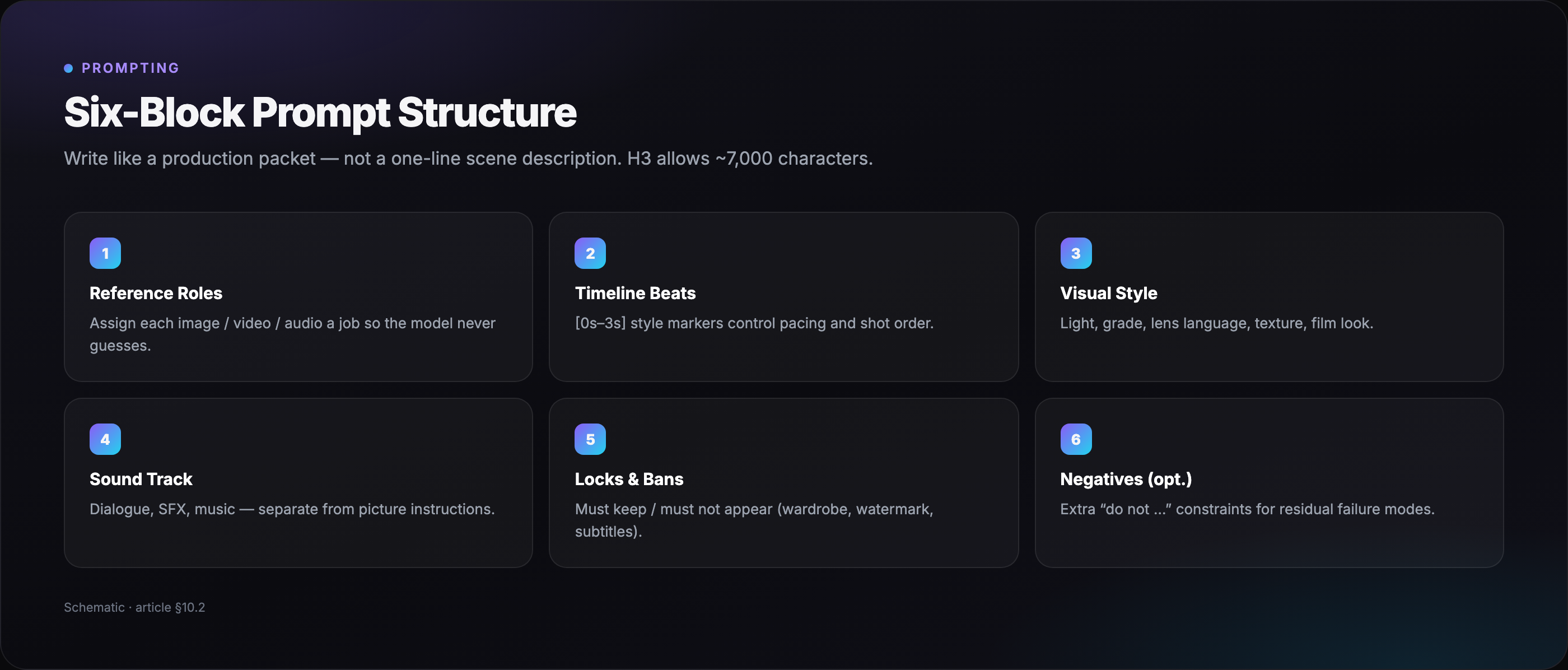
10.2 Recommended Structure (The Six-Block Method)
| Section | Content | Purpose |
|---|---|---|
| 1. Reference Roles | Specific purpose for each image/video/audio asset | Prevents the model from misinterpreting asset roles |
| 2. Timeline Beats | Action and camera direction tied to specific timestamps | Controls pacing and narrative structure |
| 3. Visual Style | Lighting, color tone, camera language, texture | Unifies the overall visual look |
| 4. Audio Track | Dialogue, SFX, music cues, and entry timestamps | Precise audio-visual synchronization |
| 5. Locks & Constraints | Elements that must be preserved or prohibited | Reduces subject drift and unwanted elements |
| 6. Negative Prompt (Optional) | Prohibited elements (e.g., no XXX) | Further constrains the output |
10.3 Example 1: Pure Text-to-Video (Brand Intro)
Weak Prompt (Poor Results):
> A girl walking in the rain, cinematic.
Strong Prompt (High-Quality Results):
```text 15 seconds, 16:9, cinematic brand intro.
[0s-4s] Wide establishing shot: An empty city street on a rainy night, neon lights reflecting on wet pavement, camera slowly pushing in. [4s-9s] Medium shot: A young woman in a black trench coat enters from frame right, walking with a steady pace holding an umbrella, rain hitting the umbrella surface. [9s-13s] Close-up: She looks up into the distance with a determined expression, raindrops trickling down her cheek. [13s-15s] Camera slowly pulls back, white title text "STILL MOVING" fades in at the center of the frame in a clean, punchy font.
Visual Style: High-contrast neon color grading, subtle film grain, strong cool/warm contrast, cinematic color grade. Audio: Low rain rumble and distant traffic throughout. Subtle piano melody enters at 4s, sharp percussion hit at 13s when the title appears. Constraints: Maintain black trench coat throughout. No subtitles, no watermarks. Title text must accurately render as "STILL MOVING". ```
10.4 Example 2: Multimodal Reference Generation
Scenario: Camera movement from reference video + character from reference image + vocals from reference audio.
```text Reference Roles:
- Video 1: Provides Hitchcock dolly zoom (dolly in + zoom out)
- Image 2: Character appearance and outfit reference (must remain consistent)
- Audio 3: Vocal track and emotional reference
15 seconds, 16:9.
[0s-5s] Subject stands in the center of an empty stage under an overhead spotlight. The camera slowly pushes in with a Hitchcock dolly zoom matching Video 1. [5s-12s] Subject begins singing, lip sync and emotion strictly matching Audio 3, body swaying gently with the music. [12s-15s] Camera continues pushing in to a tight facial close-up, stage lights gradually dimming down to leave only the subject's silhouette.
Visual Style: Dramatic stage lighting, deep black background, high contrast, cinematic quality. Audio: Use Audio 3 vocals exclusively, subtle environmental reverb, no extra background music. Constraints: Character appearance, hairstyle, and outfit must strictly match Image 2; lip sync precisely synchronized with Audio 3; no subtitles, no watermarks. ```
10.5 Example 3: Product Commercial (E-Commerce)
```text Reference Roles:
- Image 1: Main product (white wireless earbuds)
- Image 2: Model's hand and usage scene reference
10 seconds, 9:16 vertical.
[0s-3s] Product rests on a clean white tabletop under soft side lighting, camera slowly orbiting around it. [3s-7s] Model's hand reaches in, picks up the earbud and puts it on in a smooth, natural motion. Close-up on product details and fit in ear. [7s-10s] Cut to a lifestyle scene: Model smiling in a cafe, earbud subtly gleams, frame freezes and fades in brand text "SOUND THAT MOVES".
Visual Style: Clean commercial look, soft lighting, sharp detail, shallow depth of field. Audio: Upbeat electronic ambient music, subtle click sound effect at 3s, soft human chuckle at 7s. Constraints: Product appearance must strictly match Image 1; text must accurately render as "SOUND THAT MOVES"; no extra text, no watermarks. ```
10.6 Example 4: Instruction-Based Editing
```text Edit based on the uploaded original video:
Preserve the camera movement, pacing, and subject motion from the original video. Replace the indoor living room background with a sunset beach by the ocean. Change the subject's outfit to a white dress. Add gentle ocean wave sounds and distant seagulls, replacing the original background audio. Keep the subject's facial expression and lip sync unchanged.
Constraints: Modify specified elements only; preserve all other motion, lighting, and pacing; do not add subtitles. ```
10.7 Common Pitfalls and Troubleshooting
| Issue | Cause | Solution |
|---|---|---|
| Text turns into garbled noise | Text requirements were not explicitly stated in the prompt | Write out the full text in the prompt and add a constraint like "must render accurately" |
| Model misinterprets reference asset roles | Asset roles were not explicitly assigned | Explicitly define the purpose of each asset in the "Reference Roles" section |
| Loose pacing, sluggish motion | Missing timeline markers | Add timestamps like [0s-3s] |
| Unwanted elements (subtitles, watermarks) | Not explicitly prohibited | Add "no subtitles, no watermarks" to the constraints section |
| Quality degrades with too many references | 12 files uploaded without assigned roles | Limit to 3–5 high-quality references with explicit role assignments |
| Very slow generation | Reference video/audio files are too large | Compress reference assets to the lowest usable file size |
10.8 Community Case Studies: How Creators Are Using MiniMax H3
Just one day after the launch of MiniMax H3, creators on X (Twitter) have already shared a wealth of real-world use cases. These examples offer a practical view of how H3 integrates into production workflows beyond official demos. Below is a curated selection categorized by application scene, complete with key workflow takeaways.
Brand Intros and Text Rendering
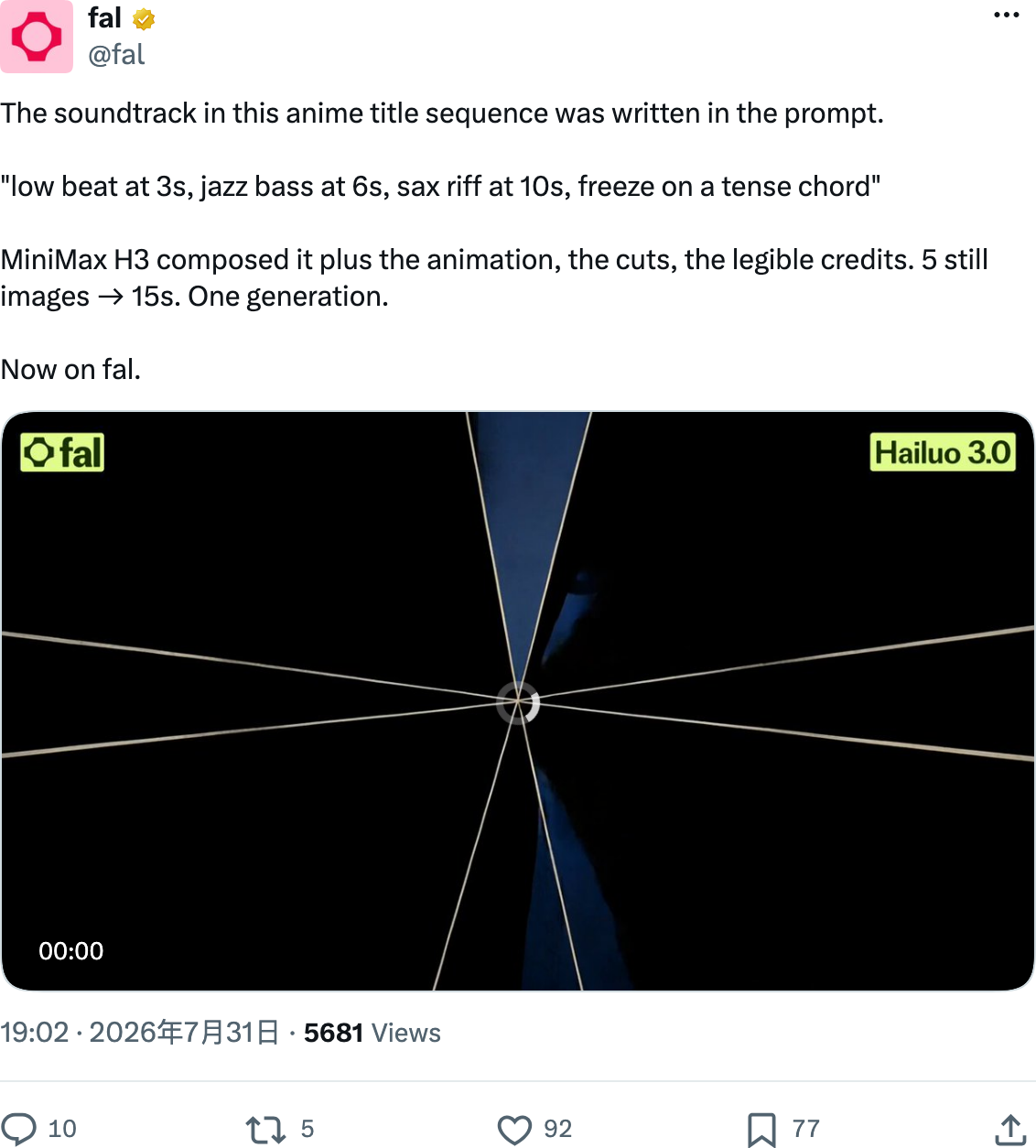
Case 1: Anime Intro with Prompt-Driven Soundtrack Timeline (@fal, 78 ❤)
Creator fal used 5 still frames as references to generate a 15-second anime-style intro. The key technique was embedding soundtrack timing cues directly in the prompt—such as low beat at 3s, jazz bass at 6s...—allowing the model to synthesize background music beat-synced with the visuals in a single pass. This demonstrates H3's ability to treat the prompt as a music cue sheet.
Case 2: Anime OP with Crisp On-Screen Text (@slash1sol, 62 ❤)
slash1s's anime opening video highlights H3's text rendering capabilities: large title typography remains crisp and perfectly legible at 2K output. This is a crucial validation for title cards in advertising, gaming, and branded content.
Product Commercials and E-Commerce
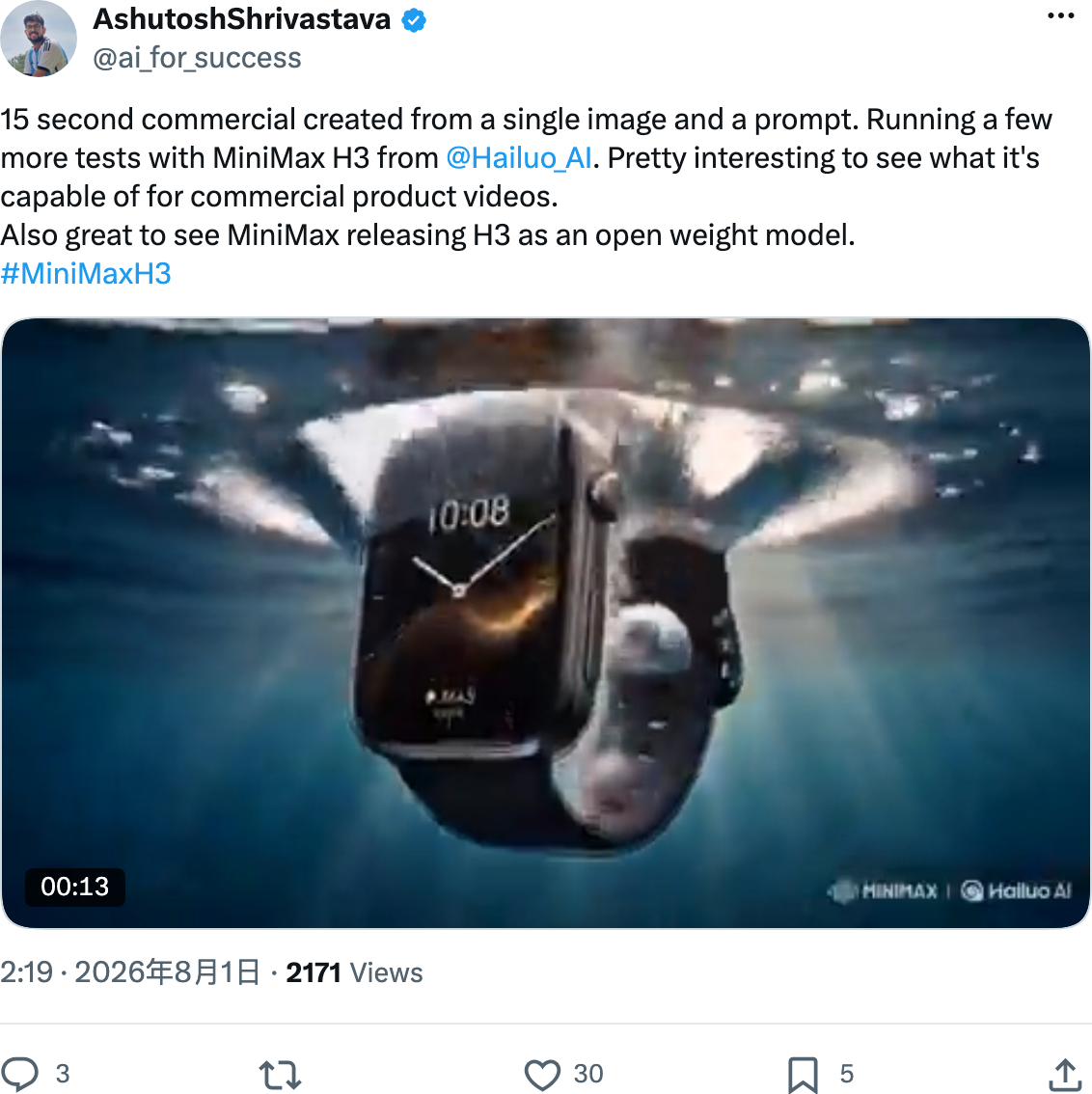
Case 3: 15-Second Product Ad from a Single Image (@ai_for_success, 12 ❤)
Ashutosh generated a commercial-grade 15-second product video using just a single product shot and a text prompt. This highlights the practical utility of H3's image-to-video (I2V) capabilities: e-commerce merchants can generate dynamic promo videos using nothing more than a clean studio product shot.
Case 4: Real Client Work — Clean Mobile UI Text Scrolling (@0xInk_, 43 ❤)
While producing an ad for a French client, INK used other models for main shots but specifically relied on MiniMax H3 for mobile UI text-scrolling shots because "the text comes out cleaner." This illustrates a pragmatic workflow insight: you don't need to generate your entire video with H3—instead, deploy it where it excels, such as text rendering and specialized shots.
Case 5: Vertical Summer Menu Commercial (@thisismariaa25, 73 ❤)
Maria converted a menu concept into a cinematic 9:16 vertical video suitable for restaurant and local lifestyle promotions. This validates H3's performance in vertical aspect ratios and demonstrates a workflow for bringing static design mockups to life.
Multimodal Reference Workflows
Case 6: Photorealistic Thriller Short with Dual Image Locks (@Diplomeme, 53 ❤)
Murphy used two reference images to lock down character identity (Image 1: subject and clothing) and environment (Image 2: bridge and cityscape), combining them with storyboarding timecodes in the prompt to generate a photorealistic thriller short. This represents a textbook implementation of dual-image role division: one image controls character identity, while the other controls environmental background without interference.
Case 7: AE Rough Animatic Driving Photorealistic Output (@seiiiiiiiiiiru, 24 ❤)
SEIIIRU demonstrated a highly creative workflow: creating a simple graphic animation in After Effects, then feeding it as a video reference into H3 to animate a static photograph following the timing and motion patterns of the animatic. This illustrates a clever application of video-to-video (V2V) motion transfer: using crude motion references to drive refined visual generation.
Case 8: Commercial Workflow Breakdown for Omni Reference (@YaseenK7212, 26 ❤)
Yaseen showcased a comprehensive multimodal workflow combining text, images, audio, and video inputs while emphasizing cross-shot consistency. Covering commercial ads, gaming, and branded content, this serves as an ideal primer for mastering H3's multimodal reference capabilities.
Case 9: Six-Asset Modular Synthesis Driven by Video Pacing (@influencer_seo, 4 ❤)
Bennett used 6 reference images as "visual building blocks" (product, character, background, etc.) alongside 1 reference video to drive pacing, transitions, and musical mood. This "images as components + video as pacing" pattern is a classic multi-reference workflow for synthesizing complex assets quickly.
Cinematic and Narrative Generation
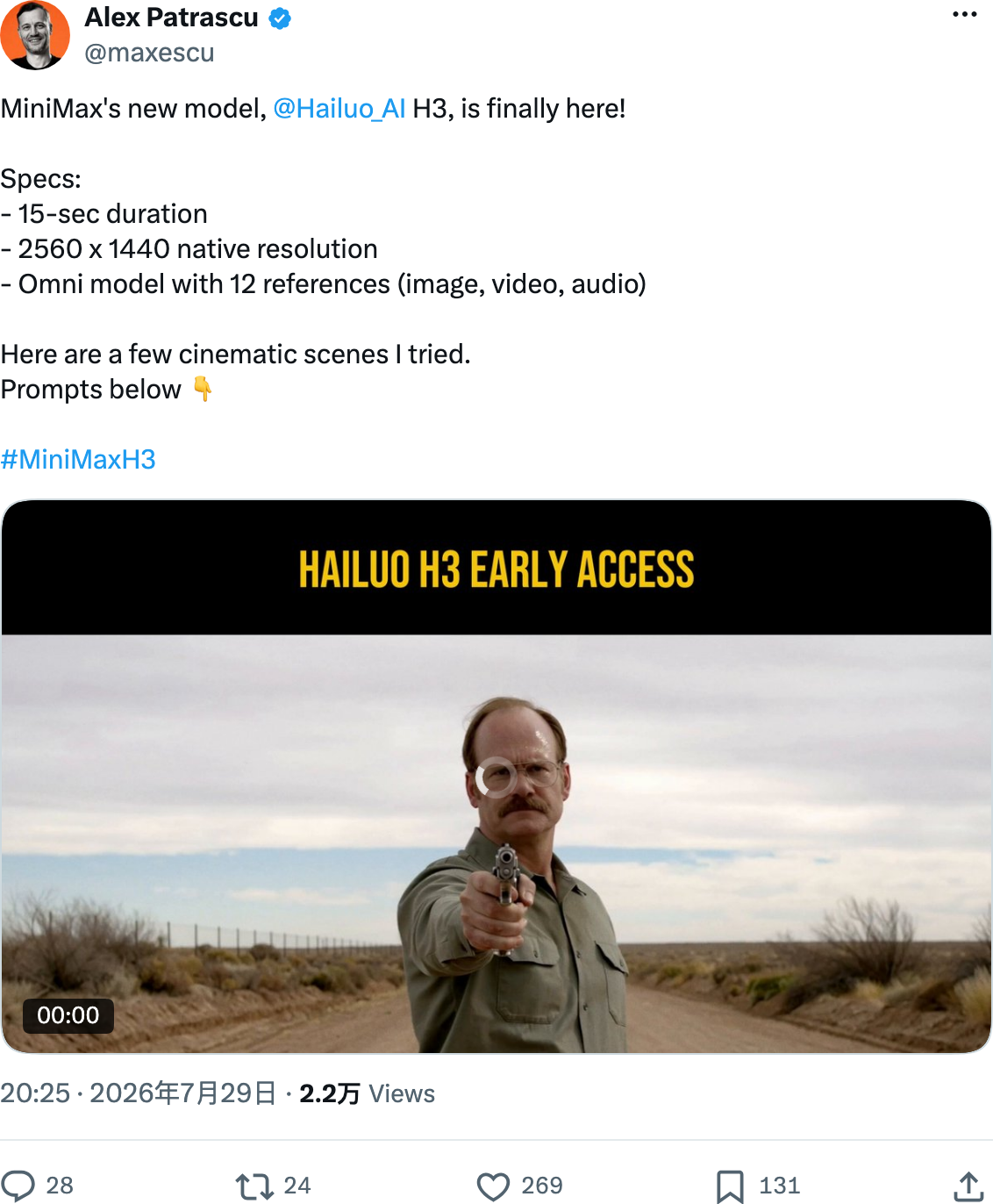
Case 10: Cinematic Multi-Shot Test Reel (@maxescu, 266 ❤ / 21k views)
Alex Patrascu's cinematic test reel became one of the most viral H3 showcases on launch day. Featuring a 15-second, 2K render generated with roughly 12 reference assets (images, video, and audio), it highlights H3's end-to-end capabilities in multi-shot directing, lighting consistency, and film texture.
Case 11: Jet Formation with Skywriting Text (@Kuriyama890, 26 ❤)
A 15-second native 2K clip featuring multi-camera cuts: formation flight, close-ups, engine ignition, and skywriting spelling out "3 is coming." This serves as a classic example of H3's multi-shot narrative execution and grand-scale environmental rendering.
Anime and Stylized Content
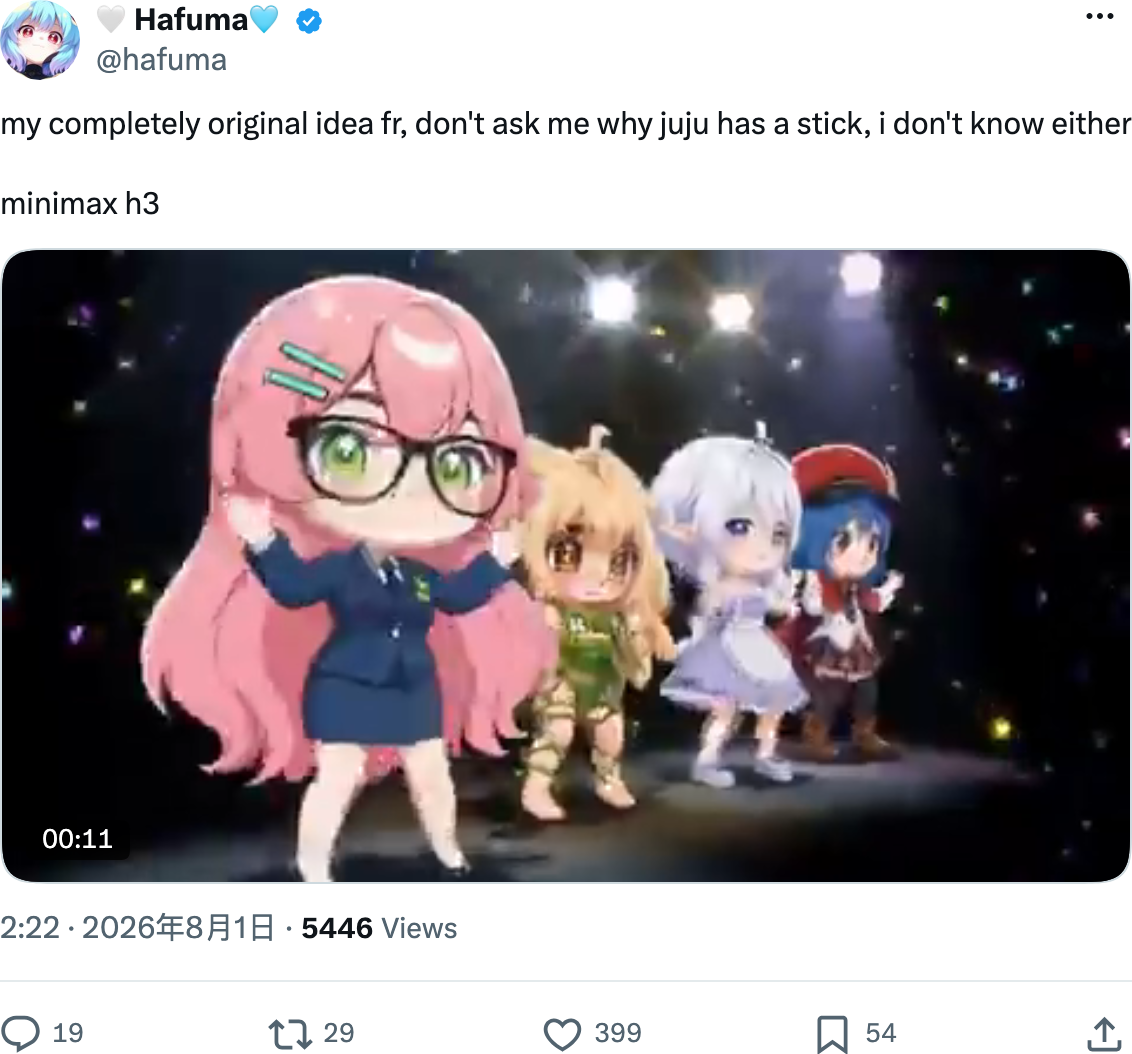
Case 12: Original Anime Short Film (@hafuma, 119 ❤)
Hafuma's character-driven anime short received high engagement across the community. It validates MiniMax H3's proficiency in stylized anime production—achieving production-ready benchmarks across character consistency, fluid animation, and style preservation.
Case 13: Vertical Character Lip-Syncing (@qaHEqxyzUF99214, 18 ❤)
An early exploration of lip-syncing produced a vertical video of a speaking character. This illustrates MiniMax H3's native audio capabilities for syncing lip movements, ideal for talking-head content and character interaction scenes.
Key Takeaways
Several common themes emerge from these community case studies:
- The clearer the role assignments for reference assets, the better the output. Strategies like using dual images to lock identity and environment, or assembling six image assets with a reference video for pacing, all stem from clear task delegation.
- Prompts structured like production spec sheets yield noticeably superior output. Audio timelines, shot timecodes, and decoupled audio-visual descriptions are essential for communicating exact intent to the model.
- MiniMax H3 doesn't have to generate the entire sequence. Leveraging H3 for its core strengths—such as crisp text rendering, complex multimodal references, or specific hero shots—and combining it with other generative tools often yields the highest production efficiency.
- Broad stylistic flexibility across vertical formats, anime, photorealism, and commercial ads. MiniMax H3 isn't restricted to a single genre, though prompt structures should be tuned to match each specific style.
11. Open Weights and Ecosystem
Among all strategic variables for H3, the commitment to open weights is arguably the most impactful. If realized, H3 will become one of the most capable open-weight video generation models available, directly reshaping industry competition. However, the weight of this "if" hinges on three crucial questions: _when_ will it be released, _under what conditions_, and _can local hardware actually run it_?
11.1 The Open-Source Commitment: What Was Promised, Where Things Stand
In its official release blog post for H3, MiniMax explicitly stated that it plans to release model weights "subject to compliance with laws and regulations," while supporting community customization and adaptation for domestic Chinese silicon. Several subtle details in this statement are worth noting.
First, the prerequisite of "compliance with laws and regulations" is no mere boilerplate. China enforces strict regulatory filing and approval requirements for open-sourcing foundation models, spanning training data compliance, content safety evaluations, and algorithm filings. As a result, the release timeline for H3's weights depends not only on MiniMax's technical readiness, but also on the pace of regulatory approval.
Second, "adaptation for domestic silicon" is a deliberate strategic signal. MiniMax factored in cross-hardware compatibility early in the design process, with media reports highlighting planned support for domestic Chinese AI chips (such as Huawei Ascend and Cambricon). This sets H3 apart from open-source models tailored exclusively for NVIDIA GPUs and hints at MiniMax's broader ambitions in enterprise and public sector markets.
Regarding actual progress: As of August 1, 2026, no downloadable H3 weights, inference code, or formal model licenses have been posted to Hugging Face or GitHub. MiniMax's previously open-sourced M3 text model uses the MiniMax Community License, and H3 is expected to adopt similar terms: free for non-commercial use, free commercial use for entities with annual revenues under $20M USD (requiring attribution and notice to MiniMax), and custom licensing required for higher-revenue entities.
11.2 The Real Impact of Open Weights: Beyond Just "Making It Run"
If H3's weights are released as promised, the impact goes far beyond simply having another model to run locally. We need to evaluate this from the perspective of different stakeholders.
For enterprise users, the most immediate benefit is data security. Currently, using the H3 API means uploading all reference assets—product prototypes, brand IP, and unreleased ad concepts—to MiniMax's cloud servers. For data-sensitive sectors like finance, healthcare, and government, this is a major dealbreaker. On-premise deployment eliminates privacy concerns, though at the cost of building local GPU clusters and inference pipelines. However, because H3's parameter count remains undisclosed, the exact hardware requirements for local deployment are entirely unknown—any claims like "runs on a single 24GB VRAM GPU" or "requires 8x H100s" are pure speculation.
For the creator community, open weights allow custom fine-tuning for specific visual styles. This paradigm has already been proven in image generation—after Stable Diffusion went open source, tens of thousands of community LoRAs emerged, spanning everything from photorealism to anime, oil paintings, and cyberpunk aesthetics. If H3 opens its weights, a similar boom is likely to unfold in video. Creators and brands could fine-tune a style-specific H3 checkpoint, ensuring every generated clip maintains a unified, on-brand visual aesthetic.
For the developer ecosystem, mainstream frameworks like ComfyUI and Diffusers are expected to add support quickly. However, compared to image models, video models pose significantly higher integration hurdles—requiring specialized handling of temporal attention mechanisms, large latent memory management, and orchestrating joint audio-video inference pipelines. Consequently, ecosystem adoption may proceed more slowly than for image models, and turnkey usability may lag behind cloud APIs.
Regarding inference costs, the community typically releases quantized versions and performance optimizations soon after an open-weight model drops. However, H3's architectural complexity (combining H3-VAE, H3-Omni Transformer, In-Context Regeneration, and joint audio generation) is significantly higher than typical image diffusion models, making quantization feasibility and quality tradeoffs something that will need empirical validation.
11.3 Third-Party Platform Ecosystem
H3 launched on several third-party platforms on day one—a deployment speed rarely seen among AI video models. Here are the most noteworthy integration partners:
fal.ai was among the fastest platforms to integrate H3, offering both text-to-video (T2V) and image-to-video (I2V) modes at pricing roughly identical to the official platform (~$0.13/sec). For developers already utilizing other models on fal.ai, switching to H3 incurs almost zero friction.
EvoLink provides a unified video API aggregation service, putting H3 alongside models like Seedance, Kling, and Wan (Tongyi Wanxiang) behind a single API gateway. This multi-model routing capability is invaluable for teams conducting A/B evaluations—allowing developers to switch models using identical code and compare generated outputs side-by-side.
PixVerse posted a co-marketing demo (168 ❤) on release day, demonstrating that H3's ecosystem strategy involves proactive platform partnerships rather than passively waiting for third-party adoption.
OpenArt took a distinct integration approach—beyond piping in the H3 API, it integrated its "Characters" feature, enabling users to save and reuse character reference assets. This pairs naturally with H3's multi-reference capability, offering a compelling combo for character-driven narrative creators.
If you prefer generating and previewing in the browser, you can also run H3 text-to-video and image-to-video workflows at minimaxh3.art.
11.4 Synergies Across the MiniMax Ecosystem
H3 does not exist in a vacuum. MiniMax's product portfolio also features the M3 text LLM and the Speech series voice models, creating significant cross-product synergy potential worth examining.
The most immediate synergy lies in an M3 + H3 content pipeline. M3 handles intent understanding, storyboard scripting, and structured prompt generation, while H3 converts those prompts into video assets. This "L2L" (Language-to-Language → Language-to-Video) workflow dramatically accelerates the journey from initial concept to final cut.
A deeper synergy exists in Speech + H3 audio enhancement. While H3's native audio is impressive, its pronunciation precision and emotional nuance still lag behind dedicated speech synthesis models. Feeding high-fidelity voice audio from the Speech series into H3 as reference audio could theoretically yield professional voiceover quality combined with H3's precise lip-syncing capabilities.
Of course, these synergies remain largely conceptual for now. MiniMax has not yet released end-to-end APIs or integrated product experiences uniting M3 + H3 or Speech + H3, so real-world efficacy remains to be seen. Nevertheless, this unified vision—spanning seeing, listening, speaking, and reasoning—reflects the future direction of AI-native content generation.
12. Limitations and Risks
H3 is an exciting milestone, but enthusiasm should not displace caution. This section is not meant to dampen optimism, but rather to help build grounded expectations—understanding where the model excels makes it easier to navigate where it remains vulnerable.
12.1 Transparency: The Biggest Wildcard
Across all discussions surrounding H3, one fundamental issue remains unresolved: we know remarkably little about the model itself.
Its parameter count has not been disclosed. As a result, we cannot determine whether H3 is a lightweight tens-of-billions parameter model or a massive hundred-billion-parameter giant. Parameter size directly dictates on-premise deployment feasibility, baseline inference costs, and theoretical performance ceilings. Without this data, any speculation about whether "H3 can run on my GPU" remains ungrounded.
The composition and sources of its training dataset are similarly opaque. MiniMax strategically claims the dataset is "based entirely on real, natural data"—a wording that implies high data quality without over-reliance on synthetic datasets, but sidesteps critical questions: Where did this data originate? How much was licensed? What proportion came from web scraping? Which languages and regions are represented? In an era plagued by copyright litigation, training data compliance is not an academic debate—it is a legal risk impacting commercial viability.
Furthermore, the lack of a technical report prevents independent validation of MiniMax's technical claims. Statements such as "H3-VAE increases effective sequence length fourfold" or "heterogeneous training architecture boosts training throughput by 30%" sound compelling, but without ablation studies or comparative baselines, we cannot assess the testing conditions or generalizability of these claims.
Bottom line: H3 can currently be evaluated as a highly competitive and cost-effective commercial API, but it is too early to tell whether it will become a genuinely deployable, fine-tunable, and license-friendly open-weight foundation model. Users should monitor future disclosures from MiniMax, particularly regarding the open-weights timeline, license terms, and technical documentation.
12.2 Capability Boundaries: Beyond the 15-Second Mark
H3 excels at short clips under 15 seconds, but push beyond that threshold, and limitations emerge.
Long-form narrative consistency remains unproven. While 15 seconds is enough for concise story beats, it cannot support cinematic long takes, detailed product walkthroughs, or extended narrative arcs. Using "Extend Video" can push clips to around 30 seconds, but each extension requires a separate generation task. Maintaining cross-segment character consistency, visual style, and narrative coherence relies indirectly on reference assets—an approach whose long-term effectiveness has not yet been systematically tested or benchmarked.
Limited reliability in complex physical interactions. Section 6.6 detailed specific high-risk scenarios, but the underlying issue warrants repeating: all current video generation models understand physical dynamics statistically, not causally. The model knows that arms usually swing when a person walks, but it does not grasp gravity, friction, or momentum. Consequently, in scenes requiring precise physical dynamics—such as bouncing balls, fluid dynamics, or mechanical gearing—H3's output may look plausible at a glance but can reveal glaring physical artifacts to trained eyes.
Unpredictable generation speeds. Real-world latency, real-time factors (RTF), and concurrent throughput metrics for H3 remain undisclosed. While Artificial Analysis provides price and quality benchmarks, reliable end-to-end latency benchmarks for MiniMax's official infrastructure are unavailable. For commercial projects bound by strict deadlines, variable generation speeds represent a tangible risk—users may encounter prolonged wait times or queue throttling during peak hours.
12.3 Copyright and Legal Risks: Real Lawsuits, Real Consequences
This risk is not merely theoretical. The Hailuo platform is currently facing copyright litigation brought by major rightsholders, including Disney, Universal, and Warner Bros [4]. The core allegation is that Hailuo was trained on copyrighted material and can generate recognizable copyrighted IP (such as iconic animated characters), constituting infringement.
Filed in 2025, the lawsuit saw a preliminary ruling in May 2026, where the court allowed the plaintiffs' primary claims to proceed. This moves the case into formal trial proceedings, making the final outcome uncertain. Crucially, MiniMax is not alone in facing these challenges—Seedance promised enhanced content safeguards following pressure from media owners, and Sora faces copyright scrutiny from Hollywood. This is a systemic issue spanning the entire AI video industry.
For end users, this translates into actionable precautions:
Avoid generating recognizable copyrighted characters or branded IP. Even if the model can technically produce them (e.g., generating a character resembling Mickey Mouse), the legal liabilities can be severe. Copyright litigation strategies frequently target both the platform provider and the commercial end user.
Maintain thorough audit logs. If you use H3-generated video for commercial purposes, archive all source reference files, full prompt texts, timestamps, job IDs, and human review logs. In potential legal disputes, these records serve as critical documentation for fair use or independent creation defenses.
Comply with regional content labeling regulations. For instance, China's _Measures for the Labeling of AI-Generated and Synthesized Content_ came into effect in September 2025, mandating both explicit labels (e.g., visible watermarks) and implicit markers (e.g., steganographic digital watermarks) on AI-generated text, images, audio, and video. While H3's precise implementation details remain unpublished, creators publishing content publicly bear the legal obligation to ensure proper compliance.
12.4 Safety and Ethics: Unanswered Questions
H3's multi-reference video, motion transfer, and audio conditioning capabilities lower the friction for creating deepfake content. Combining a single photograph, a video clip, and an audio track allows users to depict a synthetic persona speaking specific dialogue with targeted gestures. While immensely valuable for creative storytelling, this capability poses obvious risks if weaponized.
Official release materials have not yet provided clarity on several critical safety safeguards:
- Identity verification mechanisms (preventing unauthorized likeness usage)
- Minor safety and child protection protocols
- Safeguards and restrictions regarding public figures
- Bias and toxicity benchmark evaluations
- Red-teaming stress test results
- Moderation metrics, including prompt block rates and false-positive rates
As of writing, there is no explicit confirmation that H3 embeds robust provenance metadata like C2PA or SynthID, or resilient steganographic watermarks. While the Hailuo web interface displays an AI-generation badge [10], UI badges do not constitute machine-readable, crop-resistant, or transcode-proof provenance embedded within the output files themselves.
These gaps do not mean H3 should be avoided, but they underscore the need for heightened caution when handling real likenesses, voice clones, public figures, or commercial IP—requiring teams to implement rigorous human-in-the-loop review processes.
13. Model Selection Guide
Synthesizing the analysis across the preceding sections, this chapter distills the findings into an actionable decision matrix. Whether you are a content creator, technical lead, or enterprise buyer, this matrix will help guide your model selection.
13.1 Model Selection by Use Case
| Scenario / Use Case | Primary Choice | Secondary Choice | Rationale |
|---|---|---|---|
| High-ROI commercial shorts, ads, e-commerce | MiniMax H3 | Seedance 2.0 | Best combined value across 2K quality, instruction-based editing, and pricing |
| Flexible multi-reference, music-driven, multi-shot narrative | Seedance 2.0 | MiniMax H3 | Superior reference-driven control and motion fluidity in Seedance |
| Extra-long clips (30s+), heavy reference inputs (50+ files) | Seedance 2.5 | — | Native 30s single pass + multi-round extensions into multi-minute videos |
| Multilingual lip-sync, multi-character consistency | HappyHorse 1.1 | H3 | ~7 language lip-syncing, up to 9 character locks |
| On-premise deployment, open-source customization, R&D | Wan 2.7 | — | Apache 2.0 license, full freedom for local deployment and fine-tuning |
| Native 4K, multilingual dialogue, element binding | Kling 3.0 | Veo 3.1 | Native 4K output with dialogue support across 5 languages |
| Extreme photorealism, physical realism, high-fidelity audio | Veo 3.1 | — | 48kHz dialogue, setting the industry benchmark for physical fidelity |
| Editing and restructuring existing video | MiniMax H3 | — | Top-ranked Editing Elo (1130) with the largest competitive margin |
| Pre-viz, rapid storyboarding, high-volume iteration | Seedance 2.0 Mini | Wan 2.7 (local) | Fast turnaround, minimal cost |
| Real-time live streaming, interactive digital avatars | Not applicable | Dedicated real-time models | Current foundation video models are unsuited for real-time latency |
| Overseas localized ads (multilingual talking heads) | HappyHorse 1.1 | Kling 3.0 | Most natural lip-sync alignment |
13.2 Recommended Multi-Model Workflows
In production environments, few teams rely on a single model for their entire pipeline. Here are several proven multi-model workflow combinations:
Ad & E-Commerce Teams:
- _Ideation & Drafts:_ Seedance 2.0 Mini or local Wan 2.7 → Rapidly generate stylistic variants.
- _Precision & Final Assembly:_ MiniMax H3 → Lock brand consistency with multi-reference inputs; refine via instruction-based editing.
- _4K Delivery (when required):_ Kling 3.0 → Upscale/render for final high-res output.
Short Drama & Narrative Teams:
- _Storyboarding & Short Shots:_ MiniMax H3 → Handle multi-shot storytelling within 15-second windows.
- _Long Takes & Extended Arcs:_ Seedance 2.5 → Utilize native 30s clips and extension tools.
- _Multilingual Localization:_ HappyHorse 1.1 → Localize dialogue with natural lip-syncing.
Brand & Creative Agencies:
- _Concept Pitching:_ MiniMax H3 → Quickly generate 3–5 visual pitch concepts for clients.
- _Production:_ Select MiniMax H3 (for ROI), Kling 3.0 (for 4K), or Veo 3.1 (for realism) based on client specs.
- _Client Revisions:_ MiniMax H3 instruction-based editing → Apply revisions conversationally as if working with an editor.
R&D & Developer Teams:
- _Base Exploration:_ Wan 2.7 local deployment → Experiment and fine-tune freely under Apache 2.0.
- _Commercial Benchmark:_ MiniMax H3 API → Serve as a performance and quality baseline.
- _Future On-Prem:_ MiniMax H3 open weights → Transition to local H3 deployment once weights are released.
13.3 Decision Tree
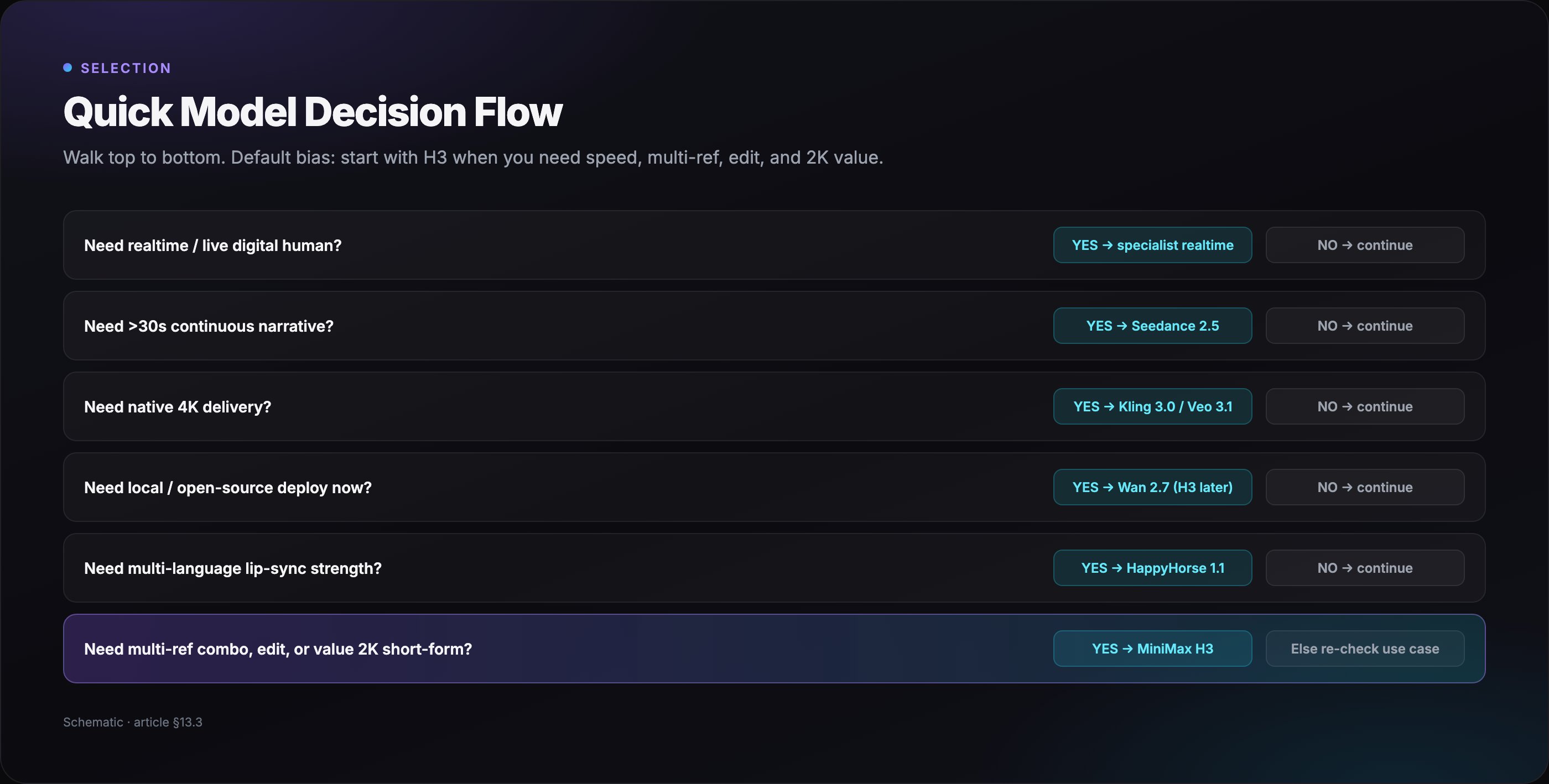
If you are unsure which model to choose, follow this quick decision tree:
- Do you require real-time generation? → Yes → H3 is unsuitable; evaluate dedicated real-time models.
- Do you need clips longer than 30 seconds in a single pass? → Yes → Seedance 2.5.
- Do you require native 4K resolution? → Yes → Kling 3.0 or Veo 3.1.
- Do you require strict on-premise deployment right now? → Yes → Wan 2.7 (today) or H3 (when weights release).
- Do you need multi-language lip-syncing? → Yes → HappyHorse 1.1.
- Do you rely on multi-reference inputs and instruction-based editing? → Yes → MiniMax H3.
- Do you need extreme physical realism and photorealism? → Yes → Veo 3.1.
- Are you cost-sensitive and need fast, high-quality turnaround? → Yes → MiniMax H3.
- Still undecided? → Start with MiniMax H3—it currently offers the best overall performance-to-price ratio as a baseline.
14. Conclusion and Outlook
14.1 Core Value Proposition of MiniMax H3
Looking across the entire evaluation, MiniMax H3's core value proposition boils down to four key pillars:
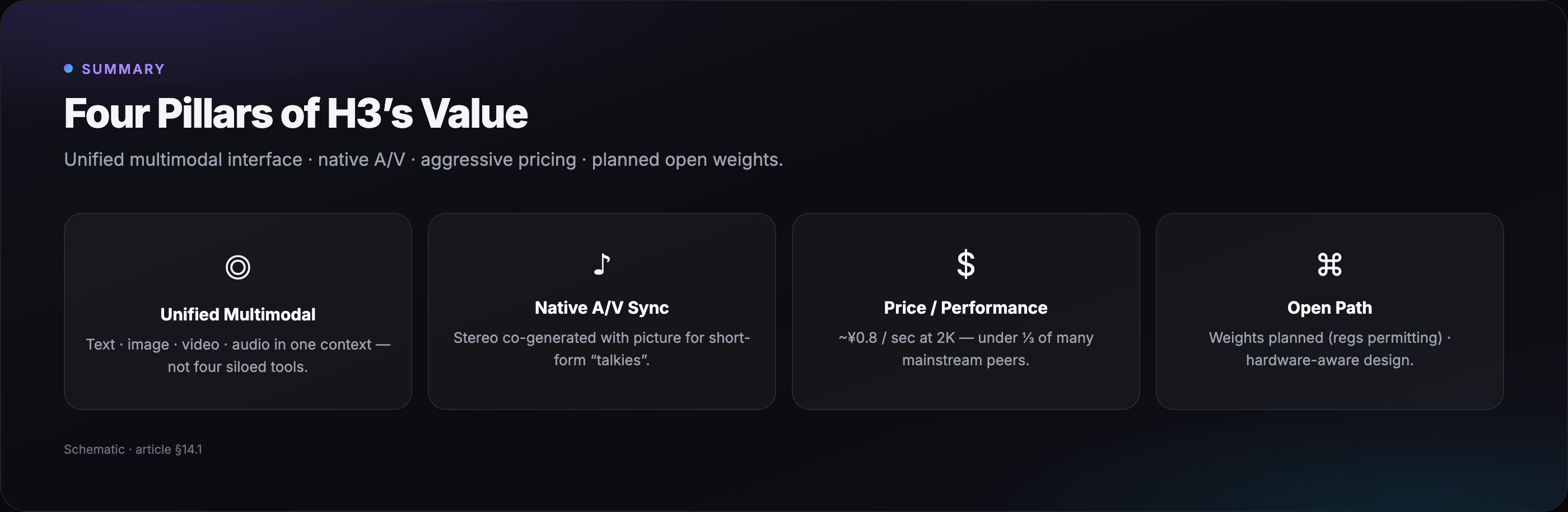
Unified Multimodal Interface. Rather than treating text-to-video, image-to-video, video editing, and audio generation as siloed tasks, H3 processes text, images, video, and audio natively within a single context window. This "omni-reference" approach sets H3 apart from competing commercial models, allowing creators to convey intent through the most intuitive method available: blending multiple reference media alongside natural language instructions.
Native Audio-Visual Synchronization. Generating dual-channel stereo audio concurrently with video frames in a single inference pass eliminates the need for separate voiceover production, audio mixing, and lip-sync alignment in post. For short-form video pipelines, this represents a leap akin to transitioning from silent films to talkies.
Unmatched Cost Efficiency. At approximately ¥0.8 RMB (~$0.13 USD) per second for 2K resolution, H3 costs less than one-third of competing mainstream models. This significantly lowers the financial barrier for solo creators and indie studios producing high-end AI video.
Promising Open-Weight Path. If MiniMax fulfills its open-weights commitment, H3 will instantly rank among the most capable open-weight video generation models, directly reshaping competitive dynamics in open-source AI.
14.2 Key Uncertainties
At the same time, critical unanswered questions linger around H3:
- Transparency: Parameter count, training dataset scale, and detailed technical reports remain unpublished, preventing independent verification of technical claims.
- Licensing & Requirements: Weights have not yet been distributed, leaving exact license terms and local hardware requirements unknown.
- Safety Frameworks: Red-teaming metrics, identity verification mechanisms, and content labeling schemas remain undisclosed.
- Copyright Litigation: Active lawsuits from rightsholders like Disney create legal uncertainty that could impact long-term commercial viability.
14.3 The Road Ahead
The launch of MiniMax H3 marks a paradigm shift in AI video generation—transitioning from single-modality tools to holistic, multimodal content creation engines. But this transformation is only beginning.
In the short term (3–6 months), key catalysts to monitor include the actual release of H3's weights, the specifics of its licensing agreement, and competitive responses from models like Seedance 2.5 and Kling 3.1. The AI video market moves at a breakneck speed, meaning H3's current edge may be challenged within months.
In the medium term (1–2 years), foundation video model capabilities will expand rapidly: longer native durations (moving from 15 seconds to multi-minute runs), higher output resolutions (2K to 4K and 8K), higher-fidelity physical simulation, and robust long-form consistency. These advances will systematically address current bottlenecks, evolving AI video from a short-clip generator into a full-funnel production engine.
In the long term (3–5 years), video generation will deeply converge with language, speech, and 3D foundation models toward genuine multimodal general intelligence. MiniMax's strategic portfolio—combining M3, H3, and Speech—is a clear first step down that path.
For creators and organizations today, the takeaway is simple: do not wait for the "perfect model." MiniMax H3 is already powerful enough to generate real commercial value across many workflows today. While its limitations and risks require a pragmatic mindset, the best strategy is to dive in, build hands-on experience, and iterate—much like H3 itself.
> Next step: Specs and leaderboards only narrow the field—fit still depends on your assets. Run a text-to-video or image-to-video job at minimaxh3.art and judge audio sync, text rendering, and iteration speed on a real clip.
References
The information in this article is compiled from the following sources, ordered by authority. Technical specifications, architecture descriptions, and feature details reflect official sources; Elo rankings and blind test metrics stem from independent third-party evaluations; pricing reflects active platform listings as of writing.
Official Sources
- MiniMax Official Blog — H3 launch announcement and technical architecture overview (Contextual Omni Representation, H3-VAE, H3-Omni Transformer, In-Context Regeneration)
- Source: https://www.minimax.io/blog/minimax-h3
- Retrieved: 2026-07-31
- MiniMax Open Platform API Documentation — Model IDs, request parameters, asynchronous task polling, supported file formats, and payload size limits
- Source: MiniMax Open Platform (api.minimax.chat)
Third-Party Independent Evaluations
- Artificial Analysis — Audio-enabled blind test Elo rankings (T2V / I2V / Editing), quality vs. price benchmarks
- Note: Elo scores measure subjective user preference rather than absolute physical accuracy or frame-by-frame reconstruction fidelity
- Source: https://artificialanalysis.ai
Industry Analysis and Deep Dives
- OrcaRouter Deep Dive — Author: Jinhao Song (2026-07-30), company background (IPO, valuation, investors), Hailuo iteration roadmap, concurrent M3 launch, 2026 competitive landscape, Sora sunset timeline
- Kie.ai Complete Guide — Author: Lukas Vogel (2026-07-30), early spec verification, pricing estimates ($1/15s 2K), price comparison with Seedance 2.0, community feedback synthesis
- DeeVid Review — Five key upgrade highlights in H3, comparison with Hailuo 02, target use case breakdown, potential shortcomings (long-sequence consistency, dialogue reliability, text rendering), prompt engineering recommendations
Chinese Media Coverage
- STAR Market Daily (Kechuangban Ribao) — H3 release coverage (2026-07-31), positioned as a "general-purpose multimodal generation model"
Third-Party Platforms and API Integrations
- EvoLink — H3 API integration page, detailed pricing ($0.130/sec), three model IDs, reference media limits, billing examples, testing budget recommendations
- Source: https://evolink.ai/zh/hailuo-3
- Atlas Cloud — H3 API page, breakdown of three API modalities, key capabilities (12 reference files, native stereo, prompt-level editing, voice transfer), competitive comparison matrix
- OpenArt — H3 model showcase page, Key Features, target use cases, prompting tips, OpenArt Characters feature integration
Community Case Studies
- X (Twitter) Creator Showcase — Launch-day community showcases covering brand intros, product commercials, multimodal referencing, cinematic storytelling, and anime styling
- Source: See links in Section 10.8